G7 allies on Friday urged a stop to attacks against civilians in the Middle East war, after a foreign ministers' meeting in France attended by US Secretary of State Marco Rubio almost one month into the US-Israeli assault against Iran.
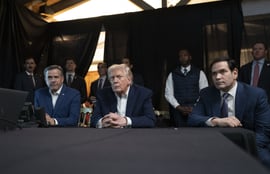
Having skipped the first day of the meeting at the historic monastery turned luxury hotel complex outside Paris, Rubio had a full day of talks with counterparts from leading industrialised democracies at the Vaux-de-Cernay Abbey outside Paris.
A final communique on the war in the Middle East called for "an immediate cessation of attacks against civilians and civilian infrastructure.
"There can be no justification for the deliberate targeting of civilians in situations of armed conflict as well as attacks on diplomatic facilities," it added.
US President Donald Trump had threatened to strike Iranian energy facilities, but subsequently rowed back that warning to give Tehran more time for talks he said were taking place.
This was Rubio's first trip abroad since the United States and Israel launched the war with air strikes on February 28 that killed supreme leader Ali Khamenei.
Before leaving France, he told reporters the US expected to finish Iran operations in the "next couple of weeks".
He said Iran had not yet responded to a plan to end the war.
But "we've had an exchange of messages and indications from the Iranian system -- whatever's left of it -- about a willingness to talk about certain things".
'Global economy hostage'
The G7 meeting was dominated by uncertainty over the current US strategy in the Middle East conflict.
"The Iranian regime would be well advised to enter into serious negotiations with the United States now," German Foreign Minister Johann Wadephul said after the meeting.
"There are initial indications that such talks should be taking place," he added, without elaborating.
Wadephul said the international community needed to collaborate even more closely now it was dealing with two wars in which Russia and Iran were cooperating -- including the conflict sparked by Moscow's 2022 invasion of Ukraine.
"We need to strengthen our unity," he told reporters.
The UK's foreign minister Yvette Cooper urged a "swift resolution to this conflict that restores regional stability".
She echoed concerns over the de facto blockade by Iran of the key Strait of Hormuz, which has driven up global oil prices and left vessels queueing up to enter the energy bottleneck.
"Iran cannot be able to just hold the global economy hostage," she said.
The final statement said ministers had "reiterated the absolute necessity to permanently restore safe and toll-free freedom of navigation in the Strait of Hormuz".
Rubio said he had made progress with allies in opposing Iranian threats to start "tolling" vessels.
"It's dangerous to the world, and it's important that the world have a plan to confront it," he said.
'Play into Putin's hands'
With Ukraine's Foreign Minister Andrii Sybiha in attendance, European ministers were keen to emphasise support for Kyiv must not be forgotten.
"Putin is cynically hoping that the escalation in the Middle East will divert our attention from his crimes in Ukraine," Wadephul said.
"This calculation must not succeed," he said, warning that any compromising on Ukraine's defence capabilities would "play into Putin's hands".
The elite G7 club -- whose origins go back to the first G6 summit held in the nearby Chateau de Rambouillet in 1975 -- and now comprises Canada, Germany, France, Italy, Japan, UK and United States.
© Agence France-Presse