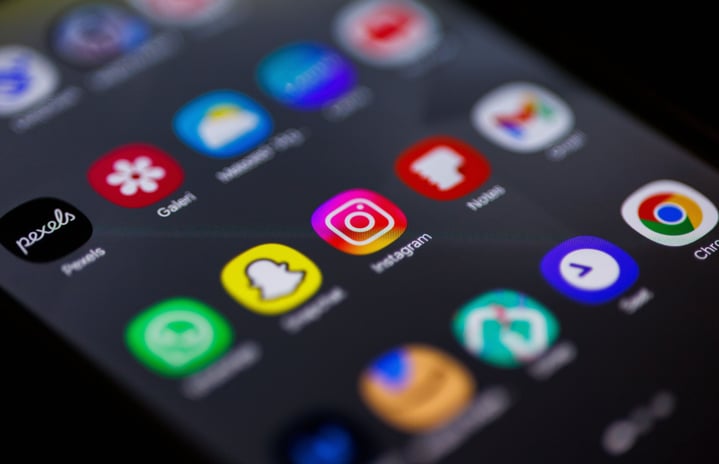
On the streets, teenagers move in clusters, phones angled towards their faces. Some film TikTok dances against the pastel backdrop of apartment blocks; others record “day in the life” videos from their bedrooms or snap their daily streaks on Snapchat. On Instagram, carefully composed selfies sit alongside beachside sunsets, fitness routines and political infographics.
This is the Maldives’ digital generation: young people whose identities, friendships, ambitions and political affiliations are increasingly mediated by platforms built around images, immediacy and virality.
For a nation scattered across hundreds of islands, social media has become a kind of connective tissue. It bridges physical distances, gives young people a way to find communities beyond their immediate surroundings and allows ideas, trends and conversations to travel from one island to another, and far beyond the country’s shores.
But the same networks that bring people together can also expose them to new pressures. Mental health concerns, privacy and online safety risks, misinformation and unequal access to reliable internet are becoming part of the digital landscape. For Maldivian youth, navigating social media is no longer simply a question of entertainment. It is increasingly part of growing up.
Platforms of choice
Instagram: Curated aesthetics
Instagram remains one of the most prominent stages for Maldivian youth. Young adults aged 18 to 34 account for roughly 65 percent of Instagram users in the Maldives, according to a research paper published by a Villa College student.
It is where young people curate their identities, showcase their lifestyles and build audiences. Scroll through Maldivian Instagram feeds and there is a familiar mix: beachside photographs, cafe’ visits, fitness routines and fashion, alongside creative work from poets, musicians and artists. Political campaigns, climate activism and mental health awareness have also found a home in the platform’s visual language.
For young women in particular, Instagram can be a space for self-presentation and negotiation between personal expression and social expectations. Another study titled “The Influence of Social Media on Relationship Dynamics among Maldivian Youth” notes that “visual storytelling plays a central role in how young women negotiate identity and self-expression, balancing modern aesthetics with cultural expectations”.
The result is often a carefully constructed balance between aspiration and authenticity. A photograph from a chic cafe’ in Male’ might appear alongside an unfiltered study session or a quiet evening at home, signalling both sophistication and relatability.
Influencers have emerged as a new class of micro celebrities, shaping everything from fashion choices to consumer habits. Local boutiques collaborate with popular creators, turning Instagram into a marketplace as much as a social network. A recommendation from an influencer can give a small business access to an audience that traditional advertising might struggle to reach.
Activism has also adapted to the platform. Campaigns focused on climate change, gender equality and mental health can gain momentum through visually compelling posts, reels and infographics. Complex issues are compressed into shareable formats, allowing young activists to take conversations beyond their own communities and, in some cases, beyond the Maldives.
TikTok: The cultural engine
If Instagram is the stage, TikTok is the engine that keeps trends moving.
Its short-form videos have become a form of cultural currency, influencing slang, humour, fashion and music. A dance that begins with one creator can appear across school corridors and university campuses within days. Comedy sketches capture the absurdities of everyday life, while trending sounds and formats give users a shared vocabulary.
Local musicians, meanwhile, are increasingly conscious of the platform’s appetite for instantly recognisable hooks. Maldivian rap and dance music are finding new audiences, with artists combining local influences and traditional rhythms with global sounds.
The platform’s recommendation system has also lowered some of the barriers to being seen. A creator from a remote island does not necessarily need an established following to reach a large audience. A single successful video can carry a previously unknown voice into homes across the country, making TikTok an important space for cultural production as well as consumption.
But the platform is not confined to entertainment.
TikTok has become a vehicle for political commentary, activism and real-time documentation. During protests and major public events, users can record and distribute footage almost immediately, allowing moments to circulate before traditional media outlets have had time to report on them.
Climate change, an existential concern for a low-lying island nation such as Maldives, is a recurring subject. Teenagers and young creators use humour, music and visual storytelling to draw attention to rising sea levels, plastic pollution and environmental degradation. The format can make an otherwise overwhelming issue accessible to audiences who might not engage with conventional climate reporting.
The platform also affects personal relationships. The study on Maldivian youth found that shared humour, trends and videos can become part of romantic exploration, with couples bonding over memes and relatable content. As the study puts it, “TikTok fosters both peer bonding and romantic exploration, embedding relationships within the rhythm of global trends.”
Snapchat: The private network
Snapchat has become particularly popular among Maldivian teenagers, prized for its disappearing messages, daily streaks and AR filters.
Unlike Instagram’s polished feeds or TikTok’s public facing performances, Snapchat is more immediate and intimate. It is where friends maintain daily contact, romantic interests can begin exchanging private messages and young people can share the ordinary details of their lives without necessarily turning them into permanent posts.
Streaks have become a peculiar but powerful measure of friendship. Friends compete to keep them alive, exchanging snaps of breakfast plates, daily commutes, work desks, sunsets or simply a blank screen with the caption ‘streak’. Individually, these moments are unremarkable. Collectively, they become a ritual. A small daily reminder that a friendship is still active.
That intimacy has also changed the way romance begins. For some young adults, private snaps can be an early stage of courtship, preceding a more direct conversation or meeting in person.
The study describes Snapchat as having become “central to modern courtship rituals”, citing the privacy and immediacy it offers compared with other platforms. Yet the disappearing nature of the content can create a false sense of security. Messages may vanish from the app, but screenshots, recordings and other forms of capture can make supposedly temporary interactions permanent. This creates concerns around harassment, consent and the circulation of private material.
Facebook: The fading giant
Globally, Facebook is increasingly associated with an older generation, and the Maldives is no exception. Yet the platform remains influential, particularly for community groups, local news and political discussion.
During elections, Facebook can become a crowded arena of memes, livestreams, campaign material and heated comment threads. Community groups use it to share announcements and information, while businesses rely on established pages to reach customers.
For many teenagers, however, Facebook feels less immediate and more ‘boomer’ than Snapchat or TikTok. Its importance has not disappeared so much as shifted towards older users and community-based communication.
Identity and self-expression
Social media has become an important part of identity formation during adolescence. For Maldivian youth, these platforms provide spaces to experiment with appearance, humour, political ideas, friendships and relationships; often before those choices become part of their offline identities.
Instagram and TikTok encourage users to participate in trends and construct a public image. Snapchat offers a smaller, more intimate circle in which everyday life can be shared with less concern about how it will look to a wider audience.
There are also gender based differences in how these spaces are used. The research cited in the study points towards women making greater use of visual storytelling on platforms such as Instagram, while men have traditionally been more prominent in debate-oriented spaces such as Twitter and Facebook. These patterns are not universal, but they reflect broader expectations around how young men and women present themselves online.
Relationships, too, have moved into the digital sphere. An Instagram direct message or Snapchat exchange can precede an introduction in person, while a shared TikTok or meme can become an easy way of signalling interest.
The study describes social media as “the primary site of relationship initiation among Maldivian youth”, with online interaction often coming before meeting in person. In a society where face to face courtship can be shaped by family, community and cultural expectations, private digital communication offers young people another route to connection.
Cultural shifts
Few areas of youth culture have escaped social media’s influence.
Fashion trends spread through Instagram boutiques and TikTok styling videos. Hijab tutorials, streetwear, skincare routines and AR inspired makeup looks can move rapidly from international creators to Maldivian users. Local sellers respond to those trends, sometimes turning a viral look into a new product offering almost overnight.
Music has undergone a similar transformation. A song no longer needs to be played on traditional radio to become familiar. A catchy bit used repeatedly in TikTok videos can give a track a second life, while musicians increasingly create material with short-form platforms in mind.
Friendships and close social circles are similarly shaped by Instagram and Snapchat. In more conservative communities, private digital spaces can provide young people with room to explore interests and relationships before pursuing it offline.
Activism has benefited from the same reach. Young Maldivians raise awareness about climate change, corruption, gender equality and other social issues without relying entirely on traditional media organisations. A post created in the can be shared by users in a far off atoll within minutes, while Maldivians living overseas can add international perspectives to local conversations.
The influence also travels in the opposite direction. Maldivians abroad bring back global fashion, music, language and political ideas through their online networks, creating a constant exchange between the local and diaspora communities.
Risks in the social media sweep
For all its possibilities, the digital world can be an unforgiving place.
The pursuit of likes, views and followers can intensify existing insecurities. Young people are exposed to carefully edited images of bodies, lifestyles and relationships, creating expectations that are difficult to meet in ordinary life. Online bullying, peer pressure and body-image concerns can add another layer to the challenges of adolescence.
UNICEF has warned that adolescence is a particularly sensitive period and that digital environments can amplify existing risks. For the Maldives, where access to mental health remains stigmatized, the consequences of sustained online pressure deserve greater attention.
Privacy is another unresolved issue. Snapchat’s disappearing messages may make conversations feel temporary, but they do not eliminate the possibility of screenshots, recordings or distribution. Young users may also be unaware of how much information can be inferred from photographs, locations, usernames and seemingly harmless posts.
The geography of the Maldives presents another complication. While Male’ and larger population centres have relatively easy access to digital services, connectivity can be less reliable in remote islands. Unequal access can therefore become an extension of existing social and economic divides.
Then there is misinformation. Facebook groups can circulate unverified claims at remarkable speed, while recommendation algorithms can repeatedly expose users to misleading or sensational material. The problem is not simply that false information exists, but that platforms are designed to keep users engaged, and emotionally charged content can be particularly effective at doing so.
Navigating the digital tide
Yet, reducing social media to a catalogue of risks would miss much of what makes it valuable to young Maldivians.
For small businesses, the platforms have opened doors that were previously difficult to reach. Instagram shops and TikTok marketing allow young entrepreneurs to sell handmade crafts, promote guesthouses, advertise food businesses or find customers for fitness and creative services without the cost of a traditional storefront or advertising campaign.
Creative industries are benefiting too. Photographers, graphic designers, musicians, artists and other young creators can use social media as a living portfolio, displaying their work to potential clients in the Maldives and overseas.
The study suggests that social media is increasingly becoming a site of professional networking and entrepreneurship rather than simply a place for leisure. “Platforms once seen as purely social are now integral to career building and economic opportunity,” the authors note.
Digital citizenship is beginning to receive greater attention. NGOs, schools and other organisations have experimented with workshops covering online safety, responsible behaviour and digital literacy. Such initiatives remain limited in reach, but they point towards a broader understanding of what young people need to navigate an increasingly connected society.
For policymakers, the challenge is not whether social media should be part of young people’s lives. It already is.
The more pressing question is how to ensure that the digital spaces in which young Maldivians spend so much of their time are safer, more accessible and better understood. Digital literacy programmes, stronger online safety measures and accessible mental health support could help young people deal with the pressures that accompany constant connectivity. Cooperation between schools, NGOs, families, tech firms and government agencies will also be important.
For Maldivian youth, the digital tide is unlikely to recede. Social media has moved beyond being a collection of apps on a smartphone and become part of the infrastructure of everyday life.
It shapes how friendships are maintained, how romances begin, how businesses find customers, how artists build audiences and how political and social causes gain attention. The challenge for the next generation will not be deciding whether to live online, but learning how to navigate a world in which the boundaries between digital culture and everyday life are increasingly difficult to separate.


