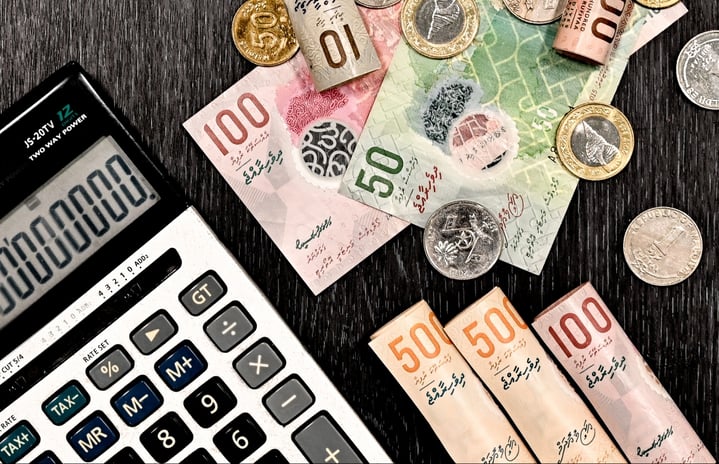
The Maldives Bureau of Statistics’ latest Quarterly National Accounts report, released on 19 July, paints a picture of an economy that is expanding in headline terms but wrestling with deep structural challenges.
Nominal GDP is rising, real GDP continues to grow, and sectors like financial services and tourism are buoyant. Yet beneath the surface, fisheries; the lifeblood of Maldivian livelihoods are in freefall, and the balance between imports, services, and domestic production is increasingly precarious.
The country is navigating the contradictions of modern economic growth; prosperity driven by tourism and finance, shadowed by the decline of traditional industries and the volatility of external dependencies.
Nominal GDP: Overall Growth, Rising Prices
At market prices, nominal quarterly GDP for Q1 2026 stood at MVR 34,398 million, an increase of MVR 2,178 million compared to the same quarter in 2025. In comparison to Q4 2025, the economy expanded by MVR 2,878 million.
The annual nominal GDP for 2025 was revised to MVR 119,204 million, up 9.7 percent from 2024. This overall growth reflects both real expansion and inflationary pressures. The implicit price deflator (IPD); a measure of overall price levels, rose to 121.2 in Q1 2026, up 3.3 percent from Q1 2025. Over the past four years, IPD growth has averaged around 3 percent, suggesting a steady upward drift in prices.
Nominal growth rates remain positive across corresponding quarters since 2022, with Q1 2026 showing 6.8 percent growth year on year and 9.1 percent quarter on quarter.
Real GDP: Slower but Steady
Strip away inflation, and the picture is more modest. Real GDP at market prices reached MVR 28,381 million in Q1 2026, up 3.3 percent year on year and 1.3 percent quarter on quarter.
The annual real GDP for 2025 was estimated at MVR 106,644 million, a 6.2 percent increase from 2024. This is respectable growth, but slower than the double-digit surges seen in earlier years.
Sector contributions to growth in Q1 2026:
- Financial services: +1.3 percent
- Wholesale and retail trade: +0.8 percent
- Accommodation and food services: +0.5 percent
- Transportation and communication: +0.4 percent
- Education, health, utilities: +0.3–0.4 percent each
- Manufacturing: -0.4 percent
- Fisheries: -1.7 percent
In other words, the engines of growth are services including finance, trade and tourism while traditional productive sectors are dragging the economy down.
Sector Breakdown
Tourism: Still the Giant
Accommodation and food services remain the largest contributor to real GDP, accounting for 24.3 percent of Q1 2026 output. The sector grew by 2 percent year on year and 7.4 percent quarter on quarter, driven by a surge in tourist bed nights.
Resorts, hotels, guesthouses, and safari vessels recorded 125,645 more bed nights than Q1 2025, and nearly 375,000 more than Q4 2025.
Tourism’s dominance is both a strength and a vulnerability. It provides foreign exchange and jobs, but leaves the economy exposed to global shocks from pandemics to geopolitical instability as is clearly felt amid the Middle East conflict.
Financial Services: A Rising Star
The financial services sector posted spectacular growth of 20.1 percent year on year and 7.2 percent quarter on quarter, with gross value added (GVA) reaching MVR 2,066 million. This reflects expansion in financial intermediation and insurance services.
Finance now contributes 7.3 percent of real GDP, surpassing sectors like construction and utilities. For a small island economy, this is a striking shift, suggesting a pivot towards service led growth.
Wholesale and Retail Trade: Import-Driven
Trade grew 10.7 percent year on year and 1.2 percent quarter on quarter, with GVA at MVR 2,371 million. The driver? Imports. Imports of goods rose by 16.1 percent year on year in Q1 2026.
This underscores the Maldives’ dependence on external supply chains. Growth in trade is less about domestic productivity and more about consumption of imported goods.
Fisheries: Collapse
The most alarming figure in the report is fisheries. GVA fell to MVR 418 million, a staggering 52.3 percent year on year decline and 39.8 percent quarter on quarter fall.
Fisheries now account for just 1.5 percent of GDP, down from 3.2 percent in 2024. For a nation historically built on fishing, this collapse is more than economic; it is cultural and existential.
Although the reasons behind this are not spelt out, the decline likely reflects overfishing, climate change impacts, dwindling number of fleets and declining baitfish.
Construction: Slow Recovery
Construction grew 3.3 percent year on year and 2.5 percent quarter on quarter, with GVA at MVR 1,166 million. The report attributes this to increased imports of building materials.
Yet construction’s share of GDP remains modest at 4.1 percent, unchanged from 2025.
Utilities: Quiet Growth
Electricity, water, and waste management grew 12.1 percent year on year and 5.3 percent quarter on quarter, with GVA at MVR 668 million. This reflects rising demand for infrastructure and services, although the sector’s share of GDP is just 2.4 percent.
Transport and Communication: Mixed Signals
Transport and communication grew 3.3 percent year on year, but shrank 0.6 percent quarter on quarter, with GVA at MVR 3,509 million. The decline reflects reduced transportation services and warehousing compared to Q4 2025.
The Bigger Picture: An Economy at a Crossroads
The Maldives’ Q1 2026 accounts reveal an economy pulled in two directions. On one hand, tourism and finance are thriving, driving growth and diversification. On the other, fisheries are collapsing, manufacturing is stagnant, and imports dominate trade.
The reliance on external demand including tourists, imports, and financial flows makes the economy vulnerable to shocks. Meanwhile, the decline of fisheries raises questions about sustainability, food security, and cultural identity.
The government faces a delicate balancing act; nurturing high growth service sectors while reviving traditional industries and ensuring resilience against external volatility.
However, the numbers alone cannot capture the human dimension. For Maldivians, the decline of fisheries is not just a statistic, it is a lived reality. For workers in tourism and finance, growth means opportunity, but also dependence on global currents beyond their control.


