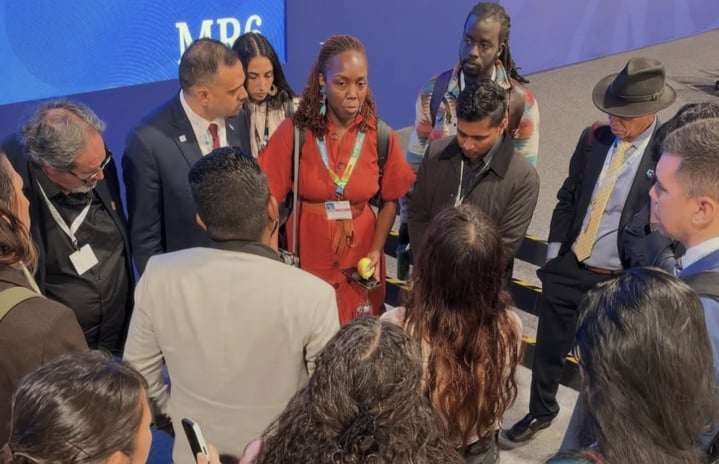
The United Nations’ 31st Conference of the Parties (COP31), held in Antalya, Turkey, concluded yesterday without reaching any major agreements, leaving many of the key outcomes hoped for by the Maldives and the Alliance of Small Island States (AOSIS) stalled.
Key Obstacles to the Main Negotiations
Since UN climate decisions require unanimous consensus from all nations, the European Union (EU), the United Kingdom, and small island states opposed the summit’s final draft text. The primary reasons were:
● Removal of the fossil fuel phase-out clause: Under the influence of oil-producing nations, provisions to transition away from fossil fuels were dropped from the final draft. As fossil fuels are the primary driver of sea-level rise, small nations stated they would not accept an agreement that fails to address them.
● Removal of the adaptation finance target: Efforts by the Maldives and AOSIS to secure a $120 billion adaptation finance target for developing nations failed, and the figure was omitted from the agreement.
● Delays in grant-based financial assistance: Although President Dr. Mohamed Muizzu called for sustainable, grant-based funding instead of debt-inducing loans, the failure to reach a consensus means these issues have been deferred to next year's summit.
No Agreement Reached on Marine Protection
Due to the failure to pass the summit's main agreement, no new legally binding international accord was adopted regarding the ocean-climate nexus. This is a major disappointment for small nations like the Maldives, which possess vast marine territories and depend heavily on marine ecosystems.
Small nations advocated for ocean protection, alongside a fossil fuel phase-out, to be included in the main summit agreement to halt sea-level rise and ocean warming. Furthermore, the removal of the proposed $120 billion adaptation finance target will hinder access to the grant funding needed for coral reef restoration and the protection of mangroves and coastlines.
Countries also could not agree on a standard way to measure how much carbon mangroves and seagrass absorb, making it harder to trade those carbon credits.
During the COP31 discussions, technical recommendations were also presented on generating renewable energy from ocean currents and wind, sustainable fisheries, and expanding marine protected areas. Outside the main summit, several international banks and coalitions announced new projects to provide grants to small nations to help achieve the target of protecting 30 percent of the world's oceans by 2030.
With 99 percent of the Maldives consisting of oceans, the failure to pass a core COP31 agreement means there is no renewed international momentum to address the root causes of ocean warming, coral bleaching, and sea swell.
Consequently, over the coming year, the Maldives will have to rely on bilateral agreements with individual nations and utilize its direct access to the Green Climate Fund (GCF) to secure the financing needed to protect its reefs and coastlines.
Maldives' Progress and Advocacy at the Summit
Even though the main agreement did not pass, the Maldivian delegation made its voice heard on the global stage and achieved several important milestones:
● Direct access to the Green Climate Fund (GCF): It was announced at the summit that the Maldives has been approved to receive funding directly from the GCF through the Maldives Fund Management Corporation (MFMC), without needing a third party. This is the first time an island state in Asia has received this opportunity.
● Calling for fairness and accountability: While delivering the national statement, President Dr. Muizzu said the Maldives is not asking for sympathy, but for justice, accountability, and real action. He also urged international financial institutions to reform the way they provide aid.
● Renewable energy goals: The government shared its ongoing plans to cut greenhouse gas emissions to 1.52 million tons and generate 33 percent of the country's electricity from renewable energy by 2028.
According to a statement published yesterday by the Ministry of Environment on the Sarukaaru website, the Maldivian delegation affirmed that the country is always ready to support and work closely with the COP presidency to resolve the issues left unfinished at this summit.
Maldives Secures Grant Funding Under COP29
The Maldives has been selected to receive a special grant jointly provided by the COP29 Presidency and the Commonwealth Fund for Small Island Developing States (SIDS) to attract private sector investments in climate-resilient energy, water, sewerage, and housing sectors. This was officially announced last week at the high-level meeting titled "Mobilizing Green and Blue Investment for SIDS," held on the sidelines of COP31.
According to the Ministry, the primary objective of this grant is to create opportunities that boost private business investments in climate-adaptive utility services and sustainable, eco-friendly housing projects across the islands of the Maldives.