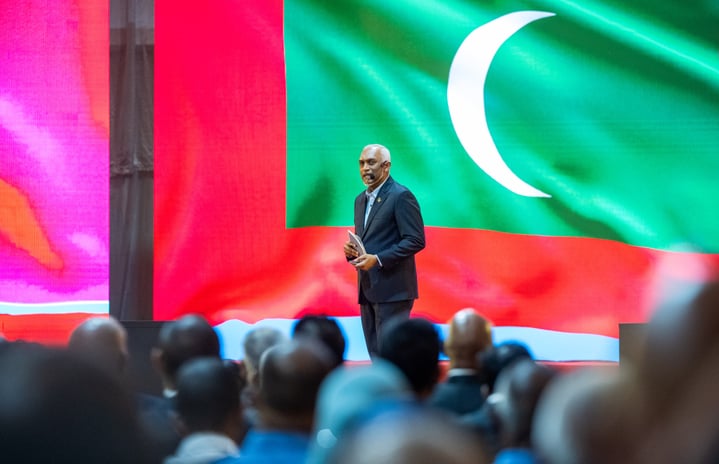
President Dr. Mohamed Muizzu has welcomed the verdict delivered today by the International Court of Justice (ICJ) in the case filed by The Gambia against Myanmar regarding the application of the Genocide Convention.
In a post on X regarding this verdict, the President stated that the ICJ's ruling is a significant advancement in the efforts being made at the international level to uphold the Convention on the Prevention and Punishment of the Crime of Genocide (Genocide Convention).
The President also stated that this verdict demonstrates the vital role played by the ICJ in upholding international legal obligations and advancing accountability through a peaceful and judicial system.
Noting that the Maldives is among the countries that intervened in the proceedings of this case, the President assured that the Maldives will always remain steadfast in preventing genocide and advancing international efforts against it.
The President stated that in addition to respecting international law to prevent such grave, inhumane crimes, the cooperation of the entire international community is immensely needed to secure justice for the victims and ensure accountability.
The President also called upon nations to cooperate in efforts to prevent genocide, ensure accountability, establish justice, and protect human dignity, and to further strengthen international relations.
The case filed at the International Court of Justice by The Gambia regarding the inhumane crimes committed by Myanmar's military to exterminate the ethnic Rohingya Muslims living in Rakhine State received immense support from the international community. Accordingly, the Maldives also decided in February 2020 to intervene in this case and officially submitted legal filings in support of The Gambia.
In addition to the Maldives, Canada, Denmark, France, Germany, the Netherlands, and the United Kingdom have also intervened in this case.
The origin of this case is linked to the intense military operation launched by Myanmar's military in Rakhine State in August 2017.
Due to thousands of Rohingya Muslims being killed, women being subjected to sexual violence, and their homes and villages being set on fire and burned down during that operation, more than 700,000 Rohingya citizens fled to neighboring Bangladesh to save their lives. UN investigative teams had determined even at that time that these were acts committed with genocidal intent.