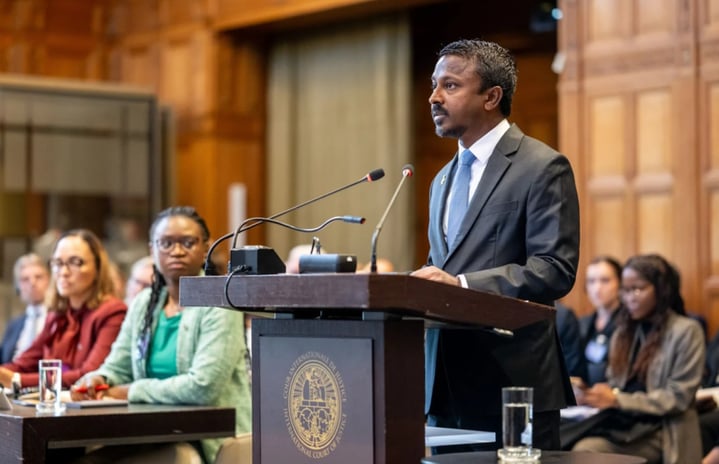
Attorney General Ahmed Usham has said the Maldives’ failure to criminalize genocide under domestic law affects the legal arguments it advances in cases before the International Court of Justice (ICJ), despite its interventions in proceedings being legally valid.
The government’s proposed amendment to the Penal Code to criminalize genocide and calls for genocide has drawn criticism over provisions that impose harsher penalties when the offences are committed by senior state officials.
In a post on X, AG Usham said the Maldives joined the Convention on the Prevention and Punishment of the Crime of Genocide on 24 April 1984 and is obligated under the treaty to enact the necessary domestic laws and establish penalties for genocide related offences.
However, he noted that the Maldives had yet to fulfil this obligation more than 40 years later. The Penal Code, enacted in 2014, did not include genocide as a criminal offence.
Usham said the absence of the offence from Maldivian law did not invalidate the Maldives’ interventions in ICJ proceedings, but affected the legal arguments it could advance regarding its obligations under the convention.
The Attorney General cited the Maldives’ intervention in The Gambia v Myanmar on 10 November 2023, under the previous administration. In its submission, the Maldives argued that states should criminalize genocide under domestic law in accordance with Article 5 of the convention, despite not having done so itself.
Maldives also intervened in South Africa v Israel on 1 October 2024, emphasizing states’ obligations to prevent genocide and punish direct and public incitement to commit it.
“To intervene in ICJ cases, it is not necessary that the offence has already been defined as an offence in the law of the state where the case is filed. Maldives intervened within the legal framework in both cases,” Usham said.
He described the absence of genocide provisions in the Penal Code as a legal shortcoming that the current government was seeking to address through the proposed amendment.
“This is not to get headlines. This is to do what needs to be done,” he said, adding that criminalizing genocide was an obligation under international law.
Under the proposed amendment, committing specified acts against a national, racial, ethnic or religious group with the intent to destroy that group, in whole or in part, would constitute an offence. Directly and publicly inciting such acts would also be criminalized.
The bill proposes classifying the offence as a first-degree felony if committed by the president, a minister, an MP, a judge or a security service commander. In other cases, it would be classified as a second-degree offence.


