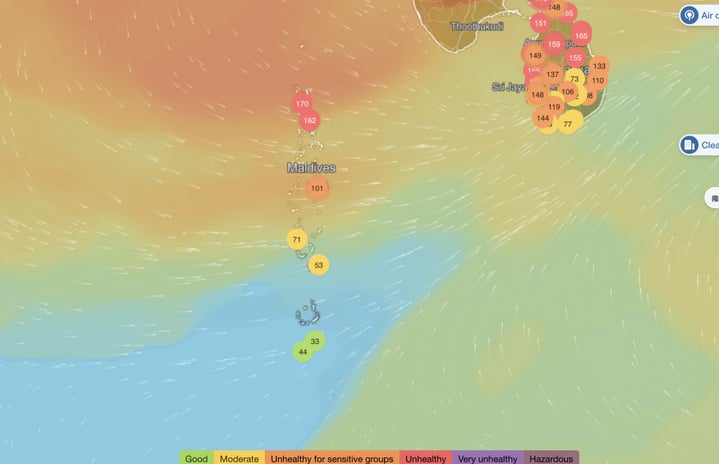
Air quality index monitors have shown that the air quality in various parts of Maldives is at dangerous levels.
The air quality monitoring system shows that Male's air quality is currently at 102.
Northern islands are experiencing the highest level of pollution. The air quality monitoring system at HDh. Kulhudhuffushi shows that the air quality on the island is at 170, and it is at 162 at Sh. Funadhoo.
50 and above on the Air Quality Index (AQI) is designated as a moderate level. However, safety measures will need to be taken. If the AQI records levels higher than 100, it is deemed dangerous for high-risk individuals. If the AQI is above 150, it will be dangerous for everyone.
The air quality at central islands is averaging between 50 and 75. The air quality on the southern islands is below 50.
Maldives is typically affected by transboundary air pollution during Iruvai (northeast monsoon), caused by dust and industrial emissions originating from northern India. With the season changing in November and the Iruvai monsoon starting in December, Maldives will once again experience the effects of haze at a high level.
The reason why the Maldivian airspace becomes polluted is because of the unclean air that comes from the northern reaches of India when the Northeast Monsoon begins. This air is made up of dust, industrial emissions and smoke from agricultural burning, along with the burning of coal for the production of electricity and the dust and smoke created from major construction projects.
The "Indian Ocean Experiment", which was conducted in 1999 by more than 200 scientists from Europe, India and America, showed that around 75 to 80 percent of this pollution comes from human activities across South Asian and South East Asian nations.
Statistics from the Health Protection Agency (HPA) have shown that respiratory diseases and illnesses have been increasing year after year during the period when air is severely polluted in Maldives.


