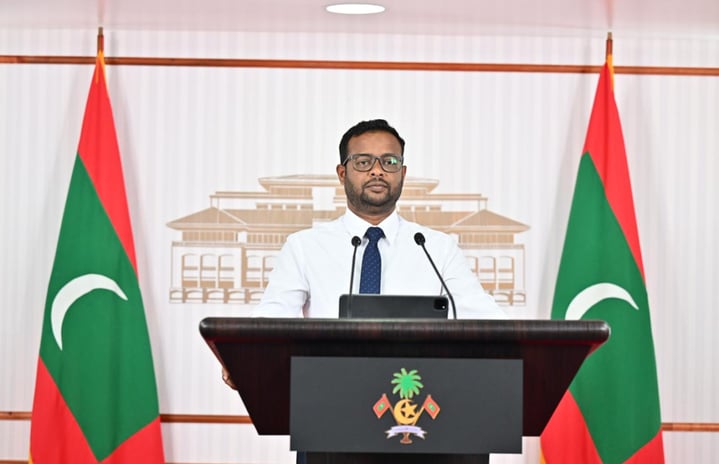
Housing Minister Dr Abdulla Muththalib has denied claims by some politicians that the UAE’s Eagle Hills project in Rasmale' is an attempt to establish a Jewish settlement in the Maldives, outlining measures the government plans to introduce to prevent such a scenario.
In a LinkedIn post today, Minister Muththalib said claims that Rasmale' would become a foothold for Zionist settlement were unfounded.
“Zionism is a project to build a Jewish state in historic Palestine, and its settlement programmes are designed to bring Jews from other countries to Israel, not to send them elsewhere,” he said.
He said Israel’s Law of Return and the agencies established around it were designed for that purpose.
Minister Muththalib said Israeli settlements had expanded into territories seized and held by military force, including the occupied Palestinian territories and the Golan Heights, as well as the Sinai Peninsula before it was returned to Egypt.
“There is no reported case anywhere of such a takeover happening through foreigners buying holiday homes or leasehold property in a sovereign country that controls its own borders, visas and land,” he said.
The Minister accused those making the claims of spreading unfounded fear and exploiting the Palestinian struggle and Maldivians’ sentiments for political gain.
“Palestinians deserve our solidarity, not to be used as a prop in our domestic politics,” he said.
Minister Muththalib said the government had barred Israeli passport holders from entering the Maldives in April 2025, a measure he said no previous Maldivian government had enacted into law.
He said the ban had been introduced despite considerable pressure against it, arguing that claims the government would compromise on the same principle through a property deal were not credible.
Eagle Hills has publicly committed to complying with the ban, he said.
However, the Minister acknowledged that the restriction applies to Israeli passports rather than Israeli citizens. He said around one in 10 Israelis were estimated to hold a second nationality and could enter the Maldives using another passport, as immigration officials could not verify dual citizenship at the border.
“That gap exists today at every resort in the country. Rasmale' does not create it, but a property purchase gives us a far better chance to close it than a border check ever could,” he said.
Minister Muththalib outlined several proposed safeguards intended to address concerns over foreign ownership and prevent Israeli nationals or Israeli-controlled entities from acquiring property in Rasmale'.
The measures include:
- Restrictions across the ownership chain: Israeli nationals and Israeli-controlled entities would be barred from acting as buyers, beneficial owners, shareholders, financiers or sales agents.
- Nationality declarations and forfeiture: Buyers and beneficial owners would be required to declare every nationality they hold or have held. False declarations would void the lease, return the property to the state and potentially result in the forfeiture of the purchase price. The checks would be repeated with every transfer.
- Residency restrictions: Eligible investors could apply for the corporate residence visa introduced in 2015 under former president Abdulla Yameen Abdul Gayoom. Muththalib said the scheme did not originally restrict applicants by nationality, including Israelis, but applications under the current government would be subject to the Israeli passport ban and the proposed nationality screening. Property ownership would not confer permanent residency or citizenship.
- Ownership caps: Limits would be imposed on the proportion of units that could be held by any single nationality or individual.
- State ownership of land: Buyers would hold leases rather than freehold titles. Leases would not allow properties to be held in perpetuity through renewal.
- Priority for Maldivians: The government aims to give Maldivians the first right to purchase a share of units in every phase, with payments made in Maldivian rufiyaa. The proposed ownership caps for foreign buyers would not apply to Maldivians.


