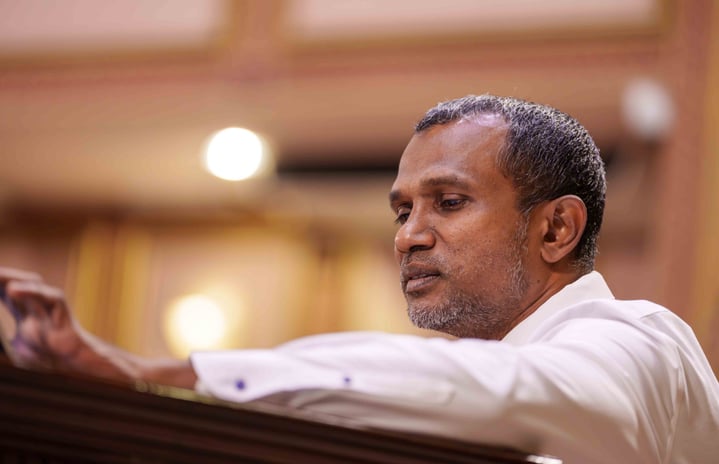
Mahibadhoo constituency MP Ahmed Thoriq (Tom) has stated that the Eagle Hills project in Rasmale' should not be stopped, and that if the terms of the project pose any losses, the parliament should address these and resolve them ahead.
In his remarks in parliament yesterday, Thoriq spoke of the impacts on the economy from various foreign investment projects taken on by successive governments, as well as from loans, and stated that the Rasmale' project will secure major assets for the country.
Thoriq described the Rasmale' project as the most advantageous project that the Maldivian State can implement. He said that the project is a green signal received while the government is working towards economic diversification.
"Not just the Rasmale' project, any project could bring with it some negative factors. What we must do is minimize these negatives or manage them. These must be controlled through laws," Thoriq said.
"If there are any economic losses to the Maldives through this, then that, too, we should minimize through the commercial agreements and laws we pass through parliament later."
Thoriq said that the project brings with it the financing for a USD 500 million housing project, as well as developing the area as a city. Whether this brings loss or gain is something that the public must decide, he said.
"What's next is whether any laws are breached. This parliament has passed a major amendment to the Constitution as well. This amendment also included land ownership by foreigners. Now, and even from the start, Maldives' land can be given to foreigners for up to 99 years," Thoriq said.
Thoriq stated that the Rasmale' project will prove to be the most beneficial foreign investment in the country if the parliament passes a special law for it along with the commercial agreements, and adequately shares these with the public.
"This is in no way the kind of project or opportunity that must be dropped," Thoriq said.
The MP went on to say that as the law was passed in 2014/2015, the government can take loans without informing the parliament, with notice to be given only after the loan is secured.
He shared that he had attempted during his previous term in parliament to change this to require governments to obtain prior approval from parliament for taking loans, but said that the efforts had been in vain.
"Now where this connects with this current bill is, when the government has such wide powers and parliament majority, there are doubts and speculations arising within public sentiment. The best way to address these is to proactively disclose to parliament all possible information," Thoriq said.
The parliament can then disclose what they are able to to the public, and then proceed from there on. This would resolve the current public misgivings, he opined.
Speaking in light of his 13 years' experience in parliament, Thoriq said that while government expenditure is higher than its revenue, the government would not be able to itself finance an undertaking at the scale of the Rasmale' project.
"How will such a project be financed? We spoke about this during the previous term as well. When 400, 500 million dollar sukuks were obtained, I was one of the loudest voices here in parliament," he said.
All the sukuk funds were used to pay salaries, and none of it went towards material assets, Thoriq explained, stating that nothing has been done to secure revenue for the State.
Instead, the government had been obligated to pay back the sukuks from the people's taxes, he said.
"When the State defaults, Dharumanvantha Hospital goes to the Dubai sukuk, Aminiya School has been mortgaged for a sukuk, Olympus has been mortgaged for a sukuk, Iskandhar School, Velana Building have been mortgaged for sukuks. So at the risk of the Maldivian State losing control of Iskandhar School, Aminiya School, Dharumavantha Hospital, they were forced to pay back the sukuk through the dollars received by the State," Thoriq explained.
"So it is because the government is obligated to pay back debt that the State does not have funds. The question then is, how do we raise financing?"
He reflected that the incumbent government had faced challenges in securing funding for housing projects, and alleged that this was caused due to the actions of politicians.
"At first, the State faced difficulties in paying back a loan taken from China's EXIM Bank or the Chinese government to construct Hiyaa Flats during former President Yameen's administration. I have heard then Minister Aslam saying in parliament during the previous term that approximately 30 to 40 percent of Hiyaa Flat residents do not pay rent. So this then has to be paid by the State to HDC, and then the funds go to a foreign country," Thoriq stated.
"Even China knows it is the government that is paying for these flats, that this is not commercially viable. So there are now no parties willing to extend loans to Maldives, foreign countries are not willing to give out loans based on Maldives' debt situation, especially for housing projects," Thoriq said, asking what options Maldives has for securing financing to implement housing projects in the country.


