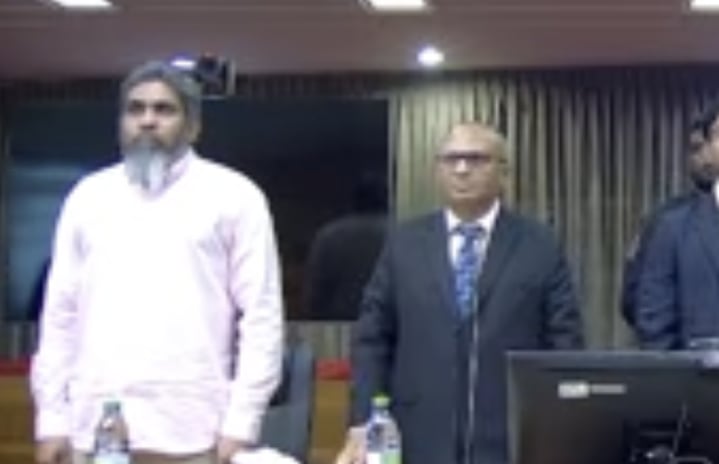
Hussain Shifaau's 109-year prison sentence, handed down for sending forged telegraphic transfers (TTs) to deceive foreign companies and obtain a large amount of goods, was not imposed in accordance with the law, according to his lawyer, former judge Husnu Al Suood.
Shifaau was arrested in 2023 over a case involving the acquisition of 1.9 million Rufiyaa worth of goods by sending forged TTs to various parties, and the state raised 23 charges against him. These included nine counts of providing a forged document, seven counts of fraud and deception, and seven counts of money laundering.
All those charges were proven, and when their punishments were combined together, they amounted to a 109-year prison sentence and a MVR seven million fine.
This is the longest prison sentence ever delivered against an individual in the Maldives. This comprises a 70-year prison sentence for money laundering charges, a 30-year prison sentence for fraud and deception charges, and a nine-year prison sentence for charges of providing forged documents.
The trial for the case began in the High Court today after Shifaau's side appealed it. Former Supreme Court judge Husnu Al Suood appeared at the High Court as Shifaau's chief lawyer.
Speaking in defense of Shifaau, Suood stated that the total period assigned to an individual reaching such a long, inconceivable duration in this case occurred because Article 1006 of the Penal Code was not applied in the manner it is required to be interpreted.
That article states that punishment for each crime proven against an offender shall be determined separately for that crime, after examining the grade of that crime and all matters that must be considered in determining punishment, considering it as the only crime proven against him.
Suood stated that the multiplying duration of punishment against Shifaau did not go as envisioned by the Penal Code. He stated that even for major crimes such as murder cases, the maximum punishment in the law is 25 years.
"There is no point in imposing a punishment that cannot be practically enforced. That is not how the Penal Code is designed. Even for murder cases, which are among the most grave crimes, it is 25 years," Suood stated.
"I do not see any benefit in that. I view determining an enforceable punishment when sentencing as something that must be done."
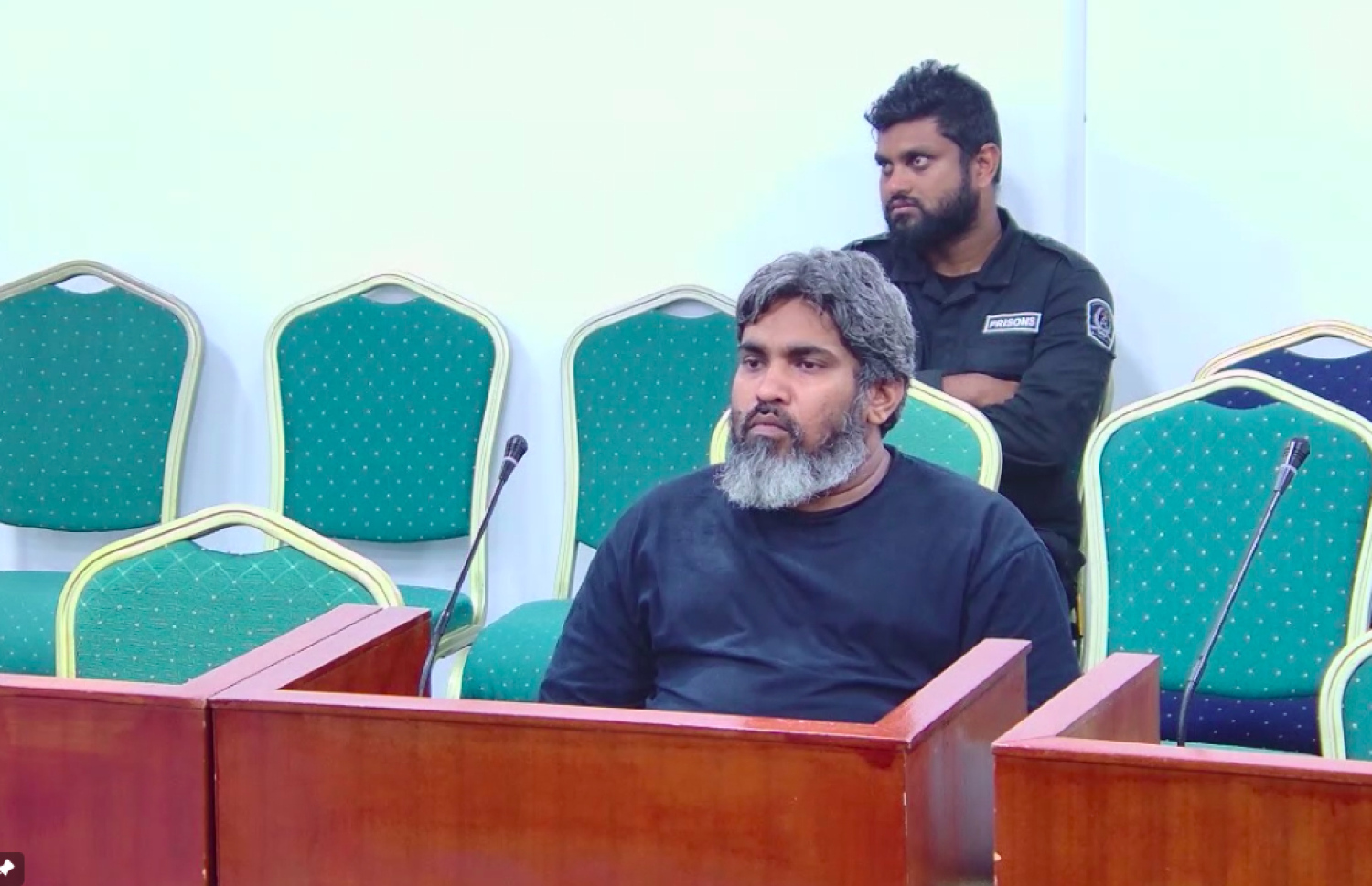
Suood stated that the High Court's role is not to interpret the law, but where there is room to establish justice, he believes a solution can be given within the principles of interpretation.
However, the state stated that this punishment was determined in accordance with the law. The state attorney stated that the 23 charges were raised in connection with various different transactions and that this case was submitted to the court as a single case to expedite the trials. There was also the opportunity to submit those charges separately, and it would have yielded the same result either way.
Therefore, the state has requested the High Court to determine that the 109-year sentence was established in accordance with the purpose of the law. Shifaau's side is requesting to nullify those sentences and send the case back to the lower court to determine punishment anew.
While the Criminal Court delivered a 109-year prison sentence against Shifaau in that case, the state had previously made a confession agreement with him to give a lenient sentence. However, the Criminal Court previously decided not to accept that agreement as it was not an agreement made with due regard to how the facts of the case transpired.
Prior to that, Shifaau was also appointed to a political position by this government. However, when the issue surfaced in the media, he was removed from the post.
While Shifaau was arrested in 2023 in connection with those cases, he traveled abroad after the court released him. Therefore, while an Interpol red notice had been issued to arrest him, he was re-arrested upon his return to the Maldives.


