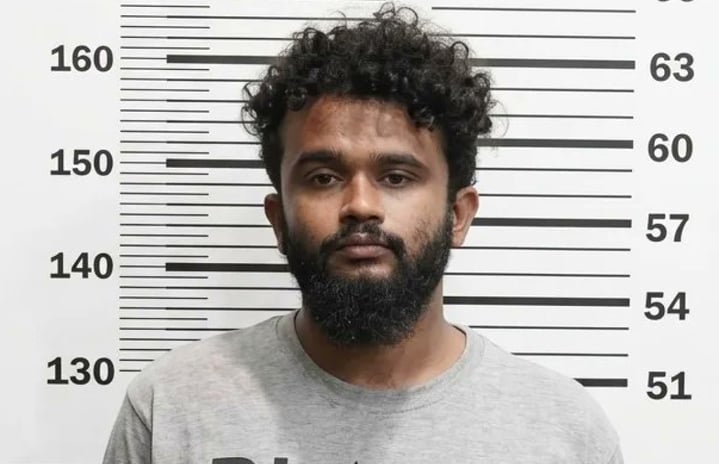
Abdulla Ibrahim (Abucha), whom police suspect to be among the most prominent individuals importing and trafficking drugs into Addu, has had his parole decision revoked and has been taken back to prison today while serving a prison sentence for drug trafficking.
The decision to revoke the parole granted to Ibrahim was made because the Parole Board's decision was concluded to be contrary to laws and regulations.
Speaking at a press conference held at the President's Office, Home Minister Ali Ihusaan stated that the period spent in prison was not calculated correctly in granting parole, and that the decision was also contrary to government policies.
As confirmed by a correctional service media official to "Mihaaru" last night, Ibrahim was released under parole on the first day of this month.
Parole is the release of a prisoner serving a sentence into the community under specific conditions before their sentence term expires.
While the Parole Board granted Ibrahim the opportunity for parole, he was freed from custody at that time after fulfilling the conditions stated in the parole law. If those conditions are violated, the prison sentence must be served again. However, the Correctional Service did not disclose which conditions were fulfilled to grant Ibrahim parole.
Parole matters are conducted by the Parole Board under the Prisons and Parole Act. A person serving a prison sentence can apply for parole upon fulfilling certain conditions. They are:
- Completing a portion of the sentence: Having spent a specific portion (generally one-third or one-half) of the ongoing prison sentence in jail.
- Good behavior: The prisoner's behavior having improved during the time spent in prison, obeying prison regulations.
- Completing rehabilitation: Having participated in religious, educational, or vocational programs conducted in prison and attempted to reform.
- No danger to society: The board being convinced that releasing him into the community poses no threat to public safety.
- Not being convicted of certain offences: Strict procedures apply when granting parole to individuals convicted of serious offences, such as murder, child sexual abuse and terrorism. In some cases, parole may not be granted.
Three sentences of 12 years and six months have been imposed on Ibrahim.
Ibrahim was sentenced in May of last year. However, he was detained under suspicion of the crime in October 2020. Therefore, it has been six years since he spent time in prison custody.
According to the parole law, except for three types of drug offenses, individuals imprisoned for other crimes will have the opportunity for parole upon serving one-third of the longest sentence imposed on them.
Serving at least half of the longest sentence imposed is required when the drug involved in an offence is diamorphine exceeding four grams; cannabis, a cannabis mixture or cannabis resin exceeding 14 grams; or any other type of drug exceeding one gram.
However, with the change now brought to the Narcotic Drugs Act, individuals who import and traffic drugs after that change will not be given the opportunity for parole.
In a police operation in Addu in October 2020, Ibrahim was intercepted at sea with 61kg of diamorphine and 17.97kg of methamphetamine racemate. A total of 18 people, including Ibrahim, were arrested during the operation.
During that operation, as police attempted to intercept Ibrahim at sea while he was transporting drugs in a dinghy, he threw sacks containing drugs into the sea and onto a vessel. However, the police jumped into the sea, retrieved those items, and arrested Ibrahim.
While two charges of drug trafficking were raised against Ibrahim, he confessed to the charges and made an agreement with the state. Based on the confession, while determining that the charges against Ibrahim were proven, a 50-year prison sentence was applicable to him. As a leniency granted for confessing, the 50-year prison sentence was reduced to 25 years.
Police suspect that Ibrahim is the most senior figure in the network importing drugs into the Maldives.
According to information previously publicized by the police office, Ibrahim is an individual who has been arrested eight times previously in drug cases. In addition to drugs, he has also been arrested in a gang rape case.
When he was arrested in mid-2019 in connection with a drug case, he was released at the court level. During the trial, he denied involvement in the case, in which drugs were found in bags carried on the shoulders. He said he was not connected to the drug case for which he was charged at the time, and that he had only taken the bags on a launch after a person involved in the case asked for his assistance.
Ibrahim's network had attempted that time as well to have one person claim the drugs as their sole property, taking responsibility for it to save everyone else. At the remand hearing, one person took responsibility for those items while everyone else denied it.


