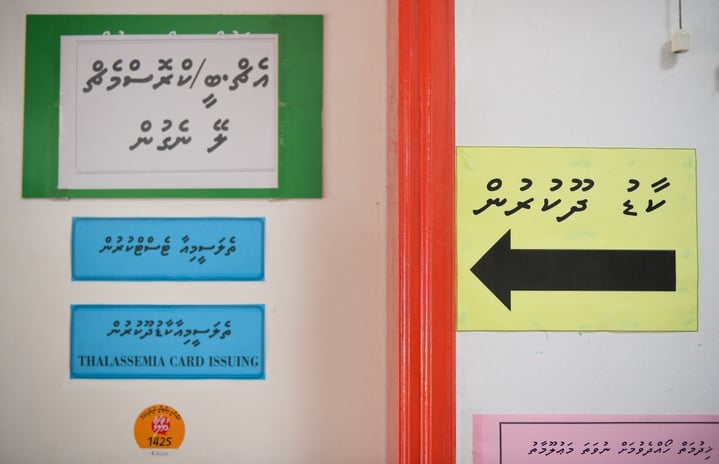
Submission of a thalassemia card has now been made mandatory when applying for marriage at any court hereafter.
While the Family Court in Malé and certain magistrate courts already practice requiring the thalassemia card alongside the marriage application form, some magistrate courts have not done so until now.
Since obtaining a thalassemia card often requires traveling to Malé, making the submission of the card mandatory had previously been left optional for the courts.
However, with the magistrate courts' regulations coming into effect tomorrow, this will change, making the submission of a thalassemia card mandatory regardless of which court a marriage application is submitted to.
The new regulations state that when applying for marriage, both individuals intending to marry must be tested for thalassemia and submit the results (the thalassemia card).
Consequently, many magistrate courts today issued announcements instructing that the thalassemia card must be submitted starting tomorrow along with applications for court-solemnized marriages.
However, the regulations specify that if neither of the two individuals intending to marry carries the trait for thalassemia, submitting the thalassemia test result for the second person will not be mandatory.
The marriage of two individuals who carry the trait for thalassemia, or two carriers, presents a possibility of producing a child requiring blood transfusions or a child with thalassemia major.
A child with thalassemia major is born only to two individuals who carry the thalassemia trait. For such a couple, with each pregnancy, there is a 25 percent chance of a child with thalassemia having the condition, and a 50 percent chance of producing a child who inherits the thalassemia trait.
Statistics released as recently as 2024 indicate that 13 children were newly registered on the thalassemia registry in that year alone, with 10 children added the previous year and 16 children added in 2022.


