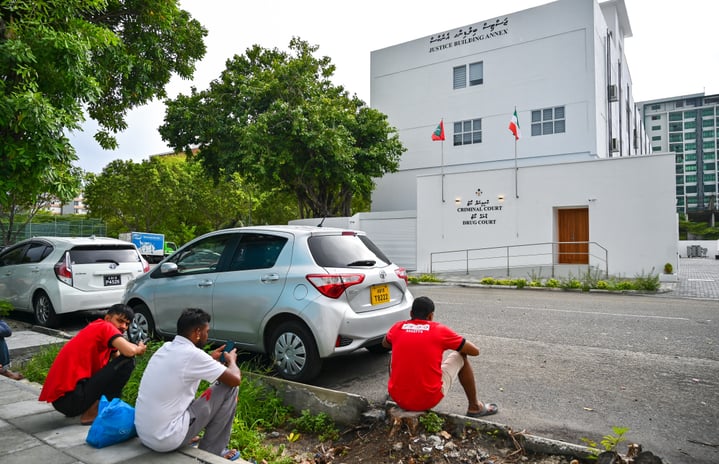
The Criminal Court has issued a judgment ordering that over MVR 150,000 stolen from an elderly person's bank account be paid to their heirs, following the victim's passing while the case was ongoing in court.
The state prosecuted Ahmed Asim and a person named Mohamed Hisham for allegedly transferring funds from an elderly individual's account to a company's account in 2021 and subsequently using those funds to purchase dollars.
The state charged the two men with exercising unauthorized control over another person's property, stating that they withdrew a total of MVR 183,700 across three separate occasions.
Of the two, Hisham worked in the same office as the owner of the funds. The victim would hand their phone to Hisham to handle tasks they did not know how to perform independently. The rightful owner passed away while the trial was ongoing in court.
In the case, the state requested that the court impose penalties for the crime and order the recovery of the lost funds.
According to the Criminal Court's ruling yesterday, it was evident that the individuals carried out the act with careful planning and coordination. The judgment noted that across the three instances, funds were transferred from the elderly person's account by compromising the email address when the phone became accessible.
Furthermore, although OTPs were typically sent to the phone, the OTPs corresponding to those three transactions were instead sent to the email.
"Looking at the available evidence, it is known that this was an act carried out secretively and with careful planning by Asim and Hisham working together," the verdict stated.
Consequently, the Chief Judge of the Criminal Court presiding over the case, Adam Mohamed, sentenced both men to one year, seven months, and six days in prison. The ruling also established that the lost amount of MVR 183,700 constitutes damages for which Asim and Hisham are liable both jointly and separately.
Since the rightful owner of the funds passed away while the case was proceeding in court, the two men were ordered to settle the payment by depositing the funds into the Civil Court within two years for distribution to the heirs.


