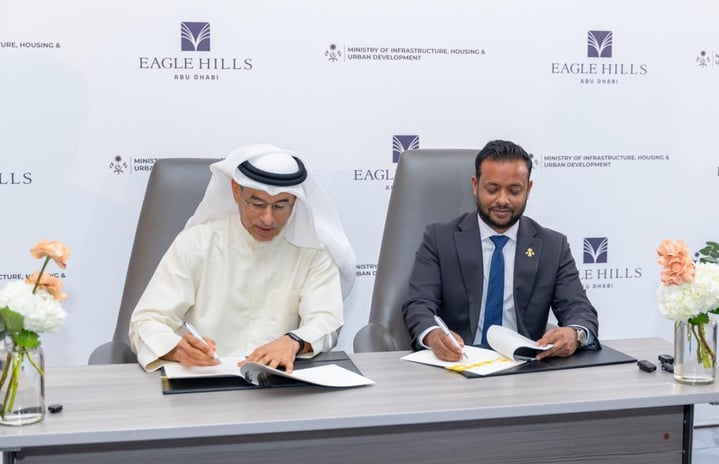
Following the government's recent signing of a USD 20 billion agreement with UAE's Eagle Hills to develop a waterfront marina at Rasmale', Minister of Infrastructure, Housing and Urban Development Dr Abdulla Muththalib has addressed concerns and questions surrounding the project.
In an article published on Linked In, Minister Muththalib stated that the project is "the largest foreign investment programme in our history, and as expected of an undertaking of this scale, it has drawn some criticism and concerns. Many of the questions raised are fair and I want to answer them directly."
The minister explained that in the Eagle Hills agreement, the State is not relying on an upfront payment, but rather on earnings through TGST, revenue share and property transactions.
"Consider how the State actually earns from tourism today. The lump sums – lease acquisition costs and land rent – are not where the money is. Tourism land rent brought in MVR 1.88 billion in 2024 and MVR 2.07 billion in 2025. Tourism GST brought in roughly MVR 9.6 billion in 2024 alone – about five times the land rent – and over MVR 10,9 billion in 2025. Acquisition fees and lease extension fees arrive as one-off payments in the years they happen. The steady, growing income comes from the tax on activity: guests arriving, spending, and coming back," he wrote.
According to the minister, the State will receive:
• TGST on every hotel stay, every meal, every shop and service in the development – the same taxes every resort pays, with no concessions.
• A 10 percent share of revenue from the master developer.
• 4 percent on every property transaction.
Further, every sale receipt from the development will be held in an escrow account in the Maldives, he stated, adding that this is in addition to the dollar revenue the government generates from the project.
"For a country that has struggled with dollar availability for as long as I can remember, that is not a footnote."
Muththalib shared that at maturity, the project is expected to bring in a minimum of one million visitors annually. Over the project's development period, the State expects more than USD 11 billion in revenue, along with the creation of 54,000 jobs.
He reiterated that the government will not be taking any loans, providing sovereign guarantees or granting any tax concessions. Further, all project funds will flow through local banks, he said.
Muththalib went on to address the long-standing concern that resort workers are required to live away from their families for a large part of the year.
"Rasmalé, on the other hand, is just seventeen minutes from Malé by speedboat. A hotel, marina, school or clinic there offers a job a Maldivian living in Rasmale or in the greater Malé region can go home from at the end of every working day. For a country that has spent fifty years exporting its young people to resort islands, that is not a small thing," he wrote.
Muththalib also addressed remarks from former President Abdulla Yameen, where he called to halt the Rasmale' project and instead build housing in Hulhumale'.
Muththalib asserted that this government, instead of choosing one over the other, is doing both.
The government has announced that as part of the agreement, Eagle Hills will be building 5,000 housing units in Hulhumale' on a contractor financing model.
"As part of this agreement, Eagle Hills will build 5,000 three-bedroom homes in Hulhumalé for Maldivian families, at a cost of between USD 400 and 500 million, and it will fund them up front, before they earn from Rasmalé a single dollar. Not one dollar of debt is added to the government, and no sovereign guarantee is given. Because we agreed a 10 percent revenue share instead of an acquisition cost, the cost of these homes is deducted from the government's share of revenue as it comes in – not from the budget, and not from borrowing," Muththalib responded.
"We chose housing, because housing is what people need most urgently and it is what helps families most directly."
Addressing concerns of whether the project places Maldives' sovereignty at risk, Muththalib simply said, "Nothing changes".
"There is no freehold. Maldivian laws and regulations apply at all times, everywhere in the development, exactly as they do in every resort. The government approves who may buy a property, and it retains full authority to issue a visa or to refuse one. There is no pathway – and there will never be a pathway – from owning a property to permanent residency or citizenship."
He asserted that the Maldives' government retains the authority to grant or cancel visas. Should the government cancel a person's visa, they must then leave the Maldives, leaving behind the property to be sold to another approved buyer, he said.
"There is also no automatic revenue the developer can claim from the State. Some will remember the GMR airport agreement, under which the government was required to impose a development charge on every passenger and hand it to the concessionaire. There is nothing of that kind here. The developer earns from what it builds and sells; it earns nothing from the Treasury," he wrote.
Former President Mohamed Nasheed, meanwhile, has called for a halt on major projects including Rasmale', citing the economic status. Opposition figures have described land reclamation as a waste of public money.
"I understand where the concern comes from, so let me be honest about the ground reality," Muththalib said in response.
"Over the years, successive governments have reclaimed hundreds of hectares of land across the country. Only a handful of those areas have full municipal services – roads, power, water, sewerage. The reason is simple: reclaiming land is the cheap part; servicing it is expensive. In today's economic situation, and with borrowing from abroad as difficult as it is, no government can build those services at the speed people want."
"So, the real waste does not lie in reclamation. The real waste is reclaimed land that sits idle and empty for a decade because there is no economy to pay for what goes on top of it."
The Rasmale'-Eagle Hills project brings in the capital to build a working city, along with the tax base which will facilitate the State to provide better services and opportunities, he argued.
The Housing Minister went on to write that while the government, alongside repaying over USD 1 billion in foreign debt, has chosen to protect households from higher bills for fundamental services such as water, electricity and fuel. The unavoidable reality is that every global shock and fuel price hike lands on the Treasury, he said.
"Without real diversification and real revenue growth, any government – this one or the next – will struggle to meet the demands on public spending and bring debt down. A responsible government has to change that trajectory for the next generation: more revenue for the State, better-paying jobs, and business opportunities for Maldivians."
"Dubai and Singapore did not become what they are because of what they collected at signing. They became what they are because of the economies those investments set in motion – the trade, the visitors, the businesses, the jobs, and the taxes on all of it, year after year. That is the model we have negotiated for: long-term sustainability, and economic and social benefit that compounds."
"The Maldives is at a crossroads. We can keep reclaiming land we cannot afford to service, or we can build an economy that pays for the services, the housing and the debt reduction that Maldivians are asking for."
The minister conceded that he understands public skepticism about mega project announcements that fail to come to fruition: "The Maldives has seen enough of those, and I have no wish to add to the list."
He emphasized that Eagle Hills and its Chairman Mohamed Alabbar are established, renowned developers counting major projects such as Downtown Dubai and Belgrade Waterfront in their portfolio.
"They have the track record and the resources to match what has been announced – and you have seen Mr. Alabbar himself, one of the best-known figures in global real estate, on record, committing to deliver it," he asserted.
"While I assure transparency in the process, I ask all Maldivians to give us their trust, and to allow us the time to show it in action."


