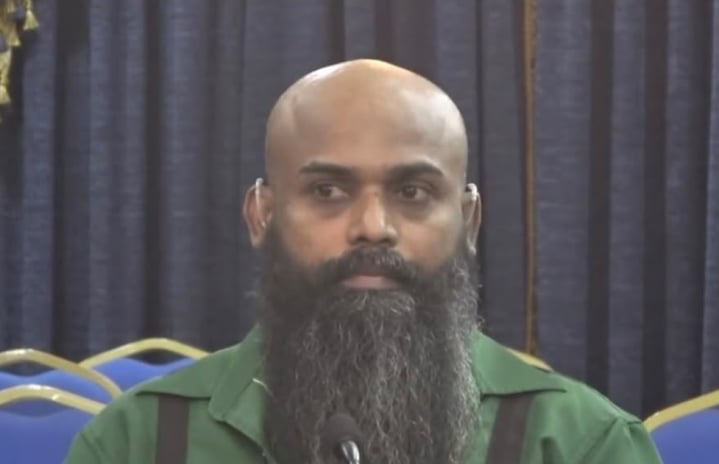
The parents of Abdulla Shuhad, who was killed in a clash at Fuvahmulah has said they wish for Qisas (just retribution/death sentence) while at the Supreme Court against Hassan Fareed, the man who was proven by the lower court to have killed Shuhad.
In 2015, the Criminal Court sentenced Fareed, of Karankaage, to death after finding him guilty of assaulting and killing Shuhad, of Meko, during a confrontation in Fuvahmulah in January 2010. High Court later upheld the conviction, after which Fareed appealed the case to the Supreme Court.
The parents of Shuhad were heard during today's Supreme Court hearing. While the trial was being discussed via a video conference provided by the Fuvahmulah Court, Shuhad's mother and father stated, as they did in the lower court, that they wished for the death penalty upon Fareed.
Before the parents were given the opportunity to speak, the court asked Fareed whether he wanted to talk to the parents. However, he said that he did not wish to speak to the parents.
Fareed attended the Supreme Court without a lawyer, with him defending himself against the death penalty.
Supreme Court concluded hearings in the case on November 15, 2021. At the time, the case was presided over by then Chief Justice Ahmed Muthasim Adnan, former justices Azmiralda Zahir, Husnu Suood, Mahaz Ali Zahir and justice Aisha Shujune Mohamed.
As a number of judges on the bench resigned, the judges bench that presides over the case has seen some changes. The current bench is headed by Chief Justice Abdul Ghani Mohamed and includes Justices Aisha Shujune Mohamed, Ali Rasheed Hussain, Hussain Shaheed and Mohamed Saleem.
With the current bench, they gave Fareed and the prosecution the opportunity to make their cases once again. During today's hearing, the prosecution requested the Supreme Court to maintain the death penalty against Fareed.
It was highlighted that Fareed's signature was missing on the documents that were presented to him after his arrest. Regarding this matter, the prosecution said that Fareed did not sign the report as he had sustained injuries to his hand and was unable to sign it. In such a situation, the document is to be signed by the attending police officer.
Nevertheless, Fareed said that he did not sustain any injuries that prevented him from signing the document and that three days after, he had signed a right to silence form.
The court ordered the prosecution to acquire documents stating the reason why Fareed was unable to sign and the medical status of Fareed at the time from the police and to submit to the court. The Chief Justice stated that as this is a murder case, he informs the prosecution to submit detailed information regarding said documents. The Chief Justice also said that after the documents are submitted, the court will move to the final hearing of the case.


