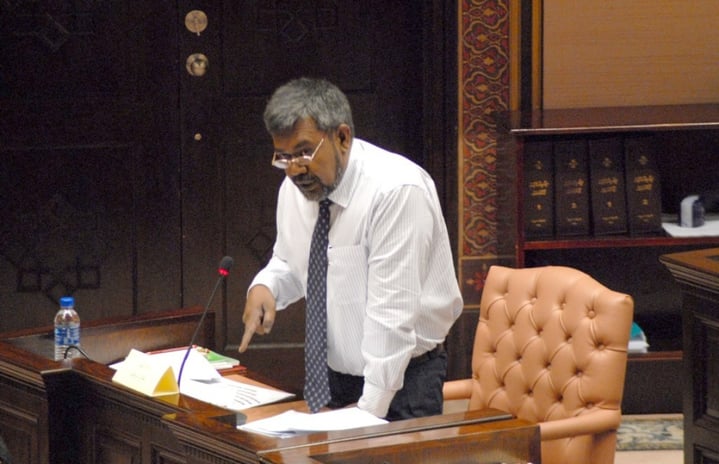
Proposals put forward so far to amend the constitution are inadequate, with the priority instead being to clarify existing provisions, former special Parliament Member Ibrahim Ismail (Ibra) said yesterday.
Ibra, who chaired the committee that drafted the current constitution, made the remarks as his brother, former MDP chair Fayyaz Ismail, and former President Mohamed Nasheed prepare to propose amendments.
Nasheed and Fayyaz outlined their ideas at a press briefing on Sunday, presenting what they described as reforms to the country’s system of governance.
Fayyaz said the model they are proposing is not a parliamentary system, but a “mixed system”. Under their proposal, the roles of head of state and head of government would be separated.
Commenting on the debate sparked by the proposals, Ibra said the Maldives does not operate a fully presidential or fully parliamentary system, but a hybrid of the two.
“The changes proposed so far are not yet good. Mainly, what needs to be done is to elaborate some articles,” he wrote on Facebook.
He said provisions that have been misinterpreted should be rewritten in clear, unambiguous terms, adding that many issues could be resolved through careful deliberation, including by the Supreme Court.
Reflecting on the drafting done 18 years ago, Ibra said the constitution was the product of extensive consultation, debate and consensus, resulting in what he described as a “mixed” system.
He added that the constitutions of 22 countries were studied in formulating the current framework, with international experts involved over several years, including specialists in Islamic jurisprudence to ensure compatibility with sharia.
Ibra described the existing constitution as among the world’s most progressive, while acknowledging that some amendments may be necessary based on issues identified over the past 16 years.
However, he said that only limited changes are needed and criticized the proposals currently under discussion.
Clarifying his stand, Fayyaz said one of the defining features of a parliamentary system is that the head of government is a member of parliament.
“That is not the proposal we are making,” he said.
Instead, he said, the plan would retain the current president as head of government while introducing a separate, elected head of state, with the possibility of renaming the role of president.
Key changes proposed by Nasheed and Fayyaz
- Electing a Head of State in addition to the Head of Government
- Head of Government to be elected through a popular vote, and Head of State to be elected through a vote amongst the members of the parliament and local councils
- The Head of State can only be dismissed through a public referendum
- Changing the composition of the parliament and controlling member numbers
- Narrowing the powers of the government and the parliament
- Judges can only be dismissed through a public vote
- Requiring obtaining public views on major matters affecting the public finances


