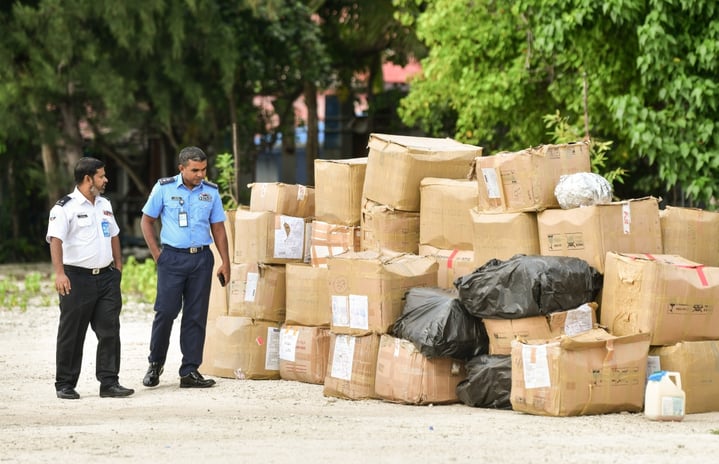
Minister of Homeland Security and Technology Ali Ihusan stated today that authorities have not yet been able to detain three individuals suspected of being stationed in regional countries and sending drugs to Maldives.
In December last year, Police stated that they have identified three Maldivians who are in Malaysia, and are sending drugs concealed in electronic items and kitchenware and appliances to Maldives via air cargo and sea cargo.
In a press conference held at the President's Office today, Minister Ihusan said that Police are continuing efforts to detain these three individuals in collaboration with Interpol and other foreign agencies. However, so far, the three remain free, he revealed.
While the illegal drug trade in Maldives expanded with major networks in play and new trends emerging, relevant institutions flagged loopholes in the 2011 Drugs Act.
The law has since been amended, with major changes brought into effect.
The government has asserted that it will be taking strong action against drug trafficking and other drug related offences.
The strictest penalties have now been laid out for drug smuggling and trafficking. As the law now stands, drug smuggling carries the death penalty.
However, the death penalty can only be imposed after certain conditions are met, and is approved unanimously by the Supreme Court bench. If a unanimous verdict for the death penalty is not reached, a life sentence will be imposed, as currently practised.
Previously, a life sentence was defined as 25 years. However, amendments removed this cap for sentences under the Drugs Act. Instead, such life sentences will mean imprisonment until death, with no eligibility for parole or pardons.