President Dr Mohamed Muizzu stated last night that even when viewed in the light of democratic best practices, it would be best to hold the presidential and parliamentary elections together.
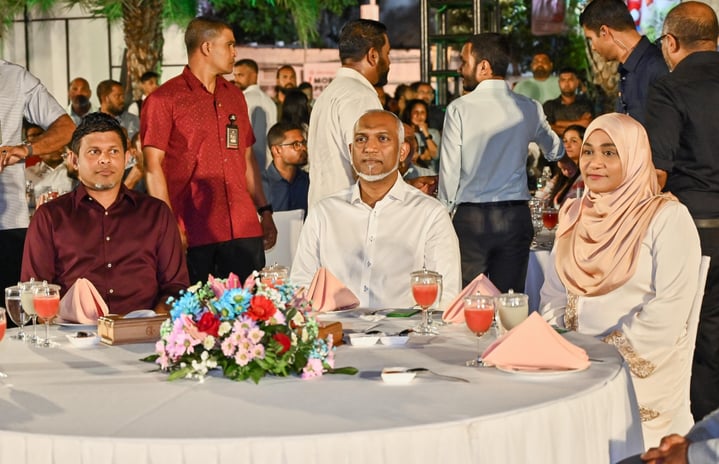
Speaking at the 'Tharaavees' (special evening feast in Ramadan) held by ruling People's National Congress last night at the Artificial Beach, the President noted that despite three separate kinds of elections being held within a span of every five years, the voter turnout is always highest for the presidential elections.
He observed that the parliamentary elections, which follows six months later, has a significantly lower voter turnout.
The President shared voter turnout statistics from 2008 onwards in his speech last night.
Presidential elections 2008
- First round: 85.3%
- Second round: 86.5%
Parliamentary elections 2009
- 70%
Presidential elections 2013
- First round: 87.2%
- Second round: 91.4%
Parliamentary elections 2014
- 78.8%
Presidential elections 2018
- 89.2%
Parliamentary elections 2019
- 81.1%
Presidential elections 2023
- First round: 79.8%
- Second round: 87.1%
Parliamentary elections 2024
- 76.9%
The President stressed that while members of parliament are elected, it is better to elect them through the votes of more people than fewer. This, he said, can be achieved through holding the presidential and parliamentary elections simultaneously.
"Even in the light of democratic principles, the best practice would be to hold both elections together. This presents a lot of benefits for the people," he asserted.
The President stated that the six month gap between the two elections causes a lot of loss, and this has been experienced in the past three elections.
"Even when we look at cost, instead of spending twice on elections, facilitating the public to make their decision on the same day brings more benefits to the people," he asserted.
The President said a newly elected leader often faces constraints created by a budget approved by the outgoing parliament, noting that his administration struggled to deliver on several fronts during its first ten months because the parliament was controlled by an opposition MDP majority.
Public Finance Act set for amendment if merger goes through
The Public Finance Act stipulates that the incumbent Finance Minister should submit the proposed State Budget for the coming year before the end of September.
President Muizzu announced last night if the referendum results are in favour of merging the two elections, amendments will be brought to the Public Finance Act.
"If the people decide to hold the two elections on the same day, then my intention is to amend the Public Finance Act and postpone the September 30 deadline for submitting the budget, and instead allow for the parliament to pass the budget in December," the President explained.
If the election merger is passed, new MPs will take oath of office on December 1, 2028. Then, it is these newly elected MPs who will pass the budget for the new administration, the President said.
"What I faced was, the outgoing parliament passed a budget for 2024 with the clear intention of obstructing our administration, and we faced a lot of challenges," the President reflected.