
President Dr Mohamed Muizzu has said the Maldives has learned that delaying action on climate change will significantly increase the cost of protection and adaptation in the future.
Delivering a keynote address at Humboldt-Universität zu Berlin during his official visit to Germany, the President said countries like the Maldives contribute negligible amounts to global greenhouse gas emissions but are among the most severely affected by climate change.
“For the Maldives, adaptation is not optional,” he said, describing it as a matter of survival and the protection of nationhood, culture and identity.
President Muizzu stressed the need to integrate climate risk into national planning and budgeting, guided by climate science. He called for scaling up financial mobilization to support adaptation and ensuring efforts are inclusive and community driven by strengthening local governance.
Describing adaptation finance as a matter of climate justice, he underscored the importance of predictable, adequate and concessional climate funding for highly vulnerable countries.
Access to early, secure and appropriate climate finance for at risk nations such as the Maldives is directly linked to climate justice, he added.
Reflecting on lessons from the Maldives’ adaptation efforts, the President said delaying action only multiplies future costs. He noted that communities are active agents of change and that coral reefs, mangroves and other natural ecosystems remain among the most effective and affordable climate defenses. Adaptation and development, he said, must go hand in hand.
Addressing the role of international partnerships grounded in science, President Muizzu said institutions such as Humboldt-Universität play a critical role in shaping collective responses to climate change by bridging science and policymaking, amplifying vulnerable voices, training future leaders and safeguarding evidence-based discourse.
“Climate change knows no borders and requires knowledge without borders,” he said, calling for solutions that move beyond narrow national interests and short-term gains.
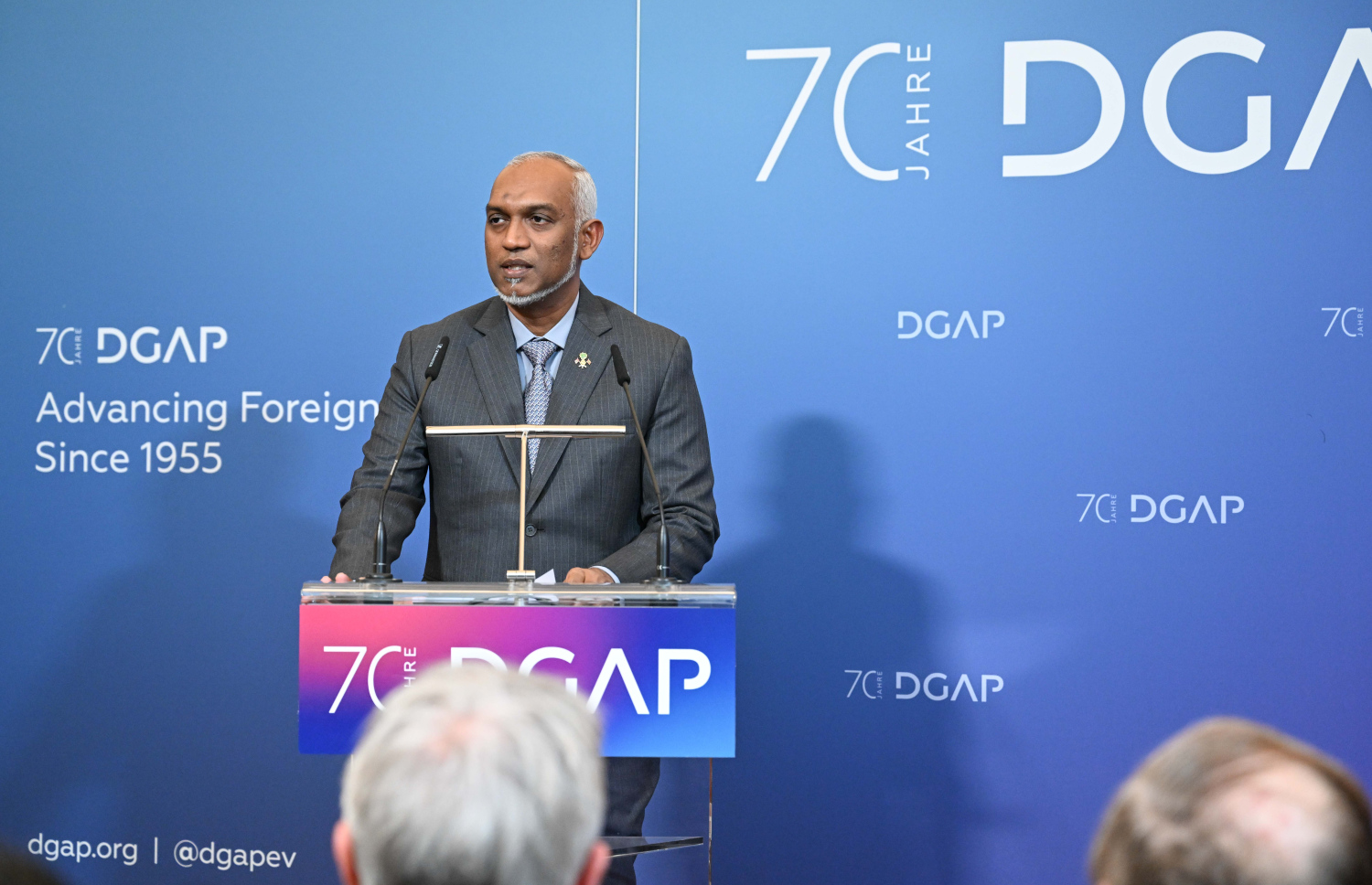
During his visit to Germany, at the invitation of the German President, President Muizzu also met with the German Council on Foreign Relations (Deutsche Gesellschaft für Auswärtige Politik, DGAP).
In his remarks there, the President outlined the Maldives’ views on ocean governance and highlighted the central role of the sea in the country’s foreign policy. Referring to the Maldives’ historical, economic, cultural and security ties to the ocean, he said climate change poses a serious threat to the country’s economy and way of life.
The visit also included discussions on strengthening bilateral cooperation, including potential collaboration on coastal protection initiatives.


