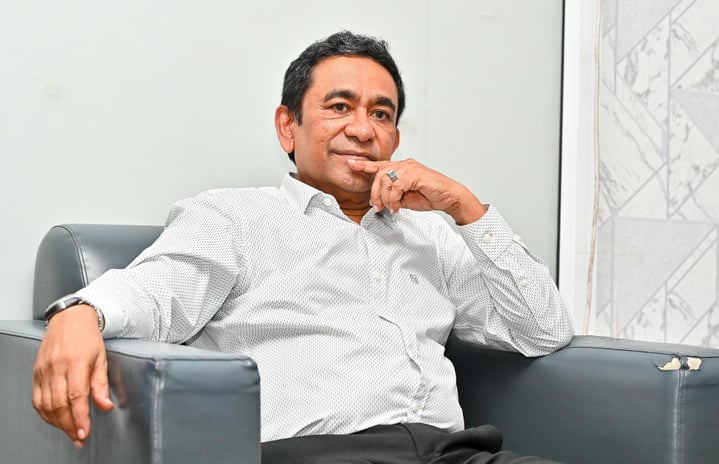
Former President Abdulla Yameen has responded to claims by some Indian journalists suggesting that Maldives could also assert sovereignty over Maliku (Minicoy/Lakshadweep), like its claim over Chagos due to geographical distance.
The remarks follow speculation in some Indian media that if Maldives argues it is the most deserving country to claim sovereignty over the Chagos Archipelago based on geographical proximity it could extend similar claims to Lakshadweep, located north of Maldives.
Speaking at a People’s National Front (PNF) meeting on Sunday night, Yameen said Maliku “belongs to the Maldivian people,” urging journalists to study history before making such claims.
“From Maliku to Addu, Maldives existed as one country,” Yameen said, noting that Maliku was historically known as part of “Malikadoo Atoll,” which he said was also among the earliest names associated with the Maldives.
He said Maliku, also known as Minicoy and now part of India’s Lakshadweep territory, was once under Maldivian rule and that Dhivehi continues to be spoken there as a result of that history.
According to Yameen, Maliku was ceded to India during the reign of Sultan Hassan IX as part of arrangements linked to resistance against Portuguese rule. He said the decision was made in what was believed to be the best interest of the Maldivian people at the time.
“While Maliku is now administered by India, it is not Indian in origin,” Yameen said, adding that historical documents support Maldives’ claims over the island.
He further argued that Maldives should seek compensation for damages caused during the Portuguese colonial period, saying records exist to substantiate such claims.
Yameen also referred to archaeological and cultural links cited in discussions about Chagos, including tomb inscriptions in the Dhivehi language, and said Indian media often acknowledge Dhivehi is spoken in Maliku without explaining the historical reasons behind it.
Recalling remarks made while he was president, Yameen said on July 26, 2015, that the loss of Maliku was a “bitter experience” for Maldives, describing colonial rule as one of the darkest periods in the country’s history.
“The former Maliku Atoll and Bodu Thiladhunmathi fell under foreign control at different times during Maldives’ long history as a single nation,” he said.
Yameen made the latest remarks at an event attended by Indian diplomats.
Historically, Maliku and the Maldives were once under the same rule before control shifted to the Arakkal dynasty of Cannanore. During the Portuguese period, when Bodu Thakurufaanu led resistance against Portuguese forces in the 16th century, Maliku was under Cannanore rule.
Members of Bodu Thakurufaanu’s family are known to have taken refuge in Maliku, and his son Kalaafaanu is believed to have spent his childhood there. The Dhivehi Ganduwaru associated with the family still remains on the island.


