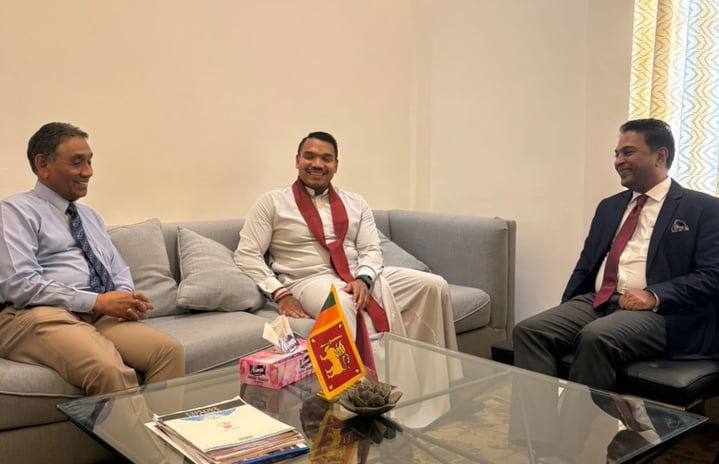
Sri Lankan opposition leader Namal Rajapaksa stated today that Sri Lanka is a "second home" for Maldivians and emphasized that constructive discussion is the most vital tool for strengthening the bond between the two nations.
His remarks came following a visit by the Maldivian Ambassador to Sri Lanka, Masood Imad, to the headquarters of the main opposition party, the Sri Lanka Podujana Peramuna (SLPP).
In a post on "X" featuring photos of the meeting, Namal, the son of former President Mahinda Rajapaksa and a current Member of Parliament, stressed that open communication is essential to bolster bilateral cooperation.
"Together, we can take our partnership to new heights," noted Namal, who has long maintained close ties with many Maldivians.
While the visit was described as a courtesy call based on a long-standing personal friendship, it occurred at a particularly sensitive time for Maldivian residents in Sri Lanka.
Ambassador Masood Imad recently voiced serious concerns regarding the "step-motherly" and disrespectful treatment Maldivians reportedly face from Sri Lankan Immigration officials.
In an interview with Sri Lanka’s Daily News, the Ambassador highlighted that Maldivians are often forced to wait in long queues from 9:00 AM to 5:00 PM, while officials appear to prioritize Western visitors.
"I am perplexed as to why officials only consider those who arrive in Sri Lanka with fair skin as visitors," Masood stated.
Ambassador Masood Imad highlighted that visa-related matters are currently processed much more easily when handled through an agent. He alleged that if a Maldivian citizen attempts to apply for a visa individually, the process becomes excessively long and difficult, often resulting in prolonged delays.
The Ambassador further accused immigration officials of deliberately complicating independent applications because they receive financial incentives from these third-party agents.
"If you apply for a visa through an agent, Maldivians are also required to pay additional fees," Masood noted.
He explained that although Sri Lanka was previously the primary destination for Maldivians seeking education and medical care, the number of travelers has significantly declined due to these systemic issues. He also shared that his office has received reports of immigration officials shouting at Maldivians and using disrespectful language within the department.
Maldivians living in Sri Lanka have been expressing similar grievances for some time. Some residents have described a "balance-based" multiple-entry system where, even if a 90-day visa is granted, only a portion of that duration can be used during the first trip, with the remaining balance supposedly transferred to a subsequent visit.
While Maldivians are currently entitled to a free 90-day on-arrival tourist visa, those residing there for longer periods allege that navigating the extension process now effectively requires paying an agent between USD 150 and USD 200 to ensure a hassle-free experience.
- The greatest difficulties are currently faced by patients seeking hospital treatment or recovering from surgeries.
- Even when medical documents are submitted stating a patient is unfit for travel, Sri Lankan Immigration often mandates that they visit specific, designated facilities for general medical tests.
- Long-term Maldivian residents are also finding it increasingly difficult to secure visa renewals.
- The Maldivian population in Sri Lanka has dropped from over 10,000 residents to between 1,000 and 1,500.
- Visa challenges and perceived discrimination against Maldivians intensified following the 2019 Easter Sunday attacks.


