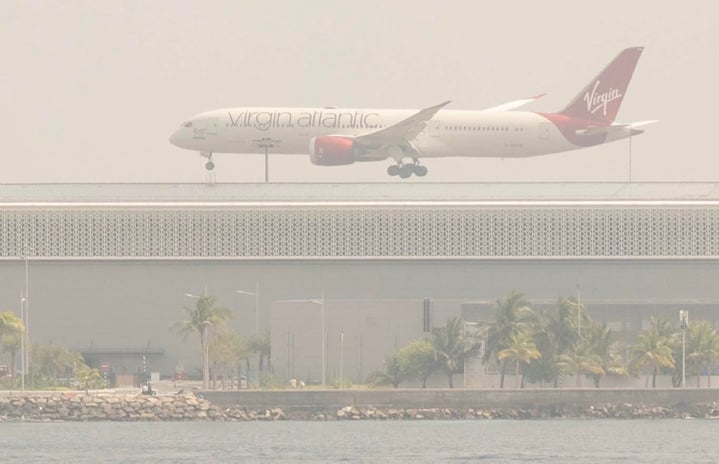
Air travel in Maldives is seeing disruptions due to the dust and industrial emissions originating from northern India.
Aviators Maldives, a company that disseminates Maldivian aviation news, posted on their website today, stating that due to the Maldivian airspace being unclear, the suspension of Visual Flight Rules (VFR) has been issued from time to time for a few days now by Velana International Airport.
The VFR is a set of guidelines that are to be observed by pilots. The main basis of the VFR is to fly planes upon the basis of sight.
The VFR states that planes may only be piloted if the weather is clear. Planes cannot be flown if it is too cold or through clouds. The guideline, set by Maldives' Civil Aviation Authority, states that a plane should be visible from as far as five kilometers while flying at a certain altitude.
However, Aviators Maldives has said that due to the hazy conditions, visibility has sometimes dropped below two kilometers in the last two to three days.
Once this occurs, the special set of VFR guidelines need to be observed instead of the regular set of guidelines.
As per Aviators Maldives, the biggest difficulty being faced due to the unclear airspace is the operation of seaplanes that usually fly at low altitudes, which disrupts the VFR.
A month passes as air remains unclear
According to IQAir records, the Maldivian airspace has been quite hazy for the past month. The air quality of the Male' region has been between 63 and 172.
An AQI between 151 and 200 is classified as unhealthy for everyone, with it being designated as a Red Alert.
As per the MET office yesterday, they estimate that the air in Maldives will be unclear for the next seven days.
The current "haze" or foggy atmosphere is a seasonal phenomenon caused by trans boundary pollution. During the transition to the Iruvai Monsoon, which began earlier than usual last year on December 17, prevailing winds carry dust, industrial emissions, and smoke from agricultural burning in northern India across the Arabian Sea to the Maldives.
With the increase in smoke, the decrease in visibility has also caused difficulties in aviation. Health issues also tend to crop up due to this.


