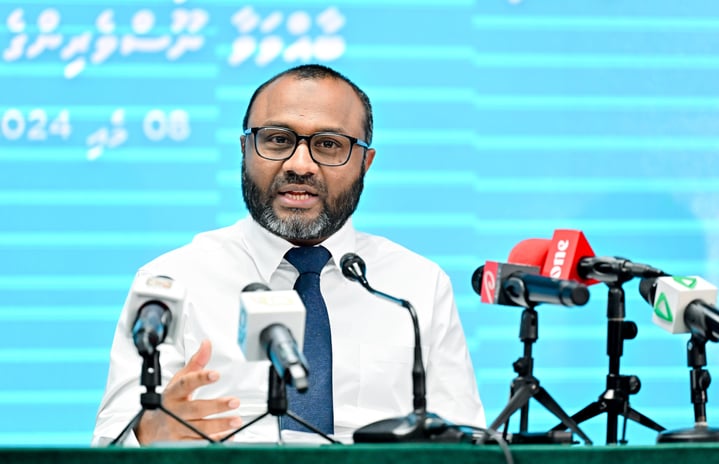
Minister of Islamic Affairs Dr. Mohamed Shaheem Ali Saeed stated yesterday that allowing preachers to conduct sermons as they please without limits may cause religious discord.
In response to former Chief Justice Dr. Ahmed Abdulla Didi (Didi) statement regarding preachers not having to necessarily preach the one sermon given by the government, Shaheem took to Facebook and expressed that he was quite against that opinion.
Shaheem said that he respects the former Chief Justice and also gave a detailed explanation to his difference of opinion.
The minister said that since not all prayer leaders (imams) in Maldives are qualified to give their own sermons, Abdulla Didi's stance is not sound. The minister also said that there are not that many scholars who can write their own sermons and memorize them word for word.
There have been cases in other nations where differences of opinion regarding faith have come about, with communities having formed and sermons preached to different sects in different mosques, causing discord.Minister of Islamic Affairs Dr. Mohamed Shaheem Ali Saeed
Shaheem stated that if prayer leaders were given permission to preach from memory, it can be a detriment to the interest of citizens as it would prolong the sermon.
"If permission is given without limit, there may be fear that Maldives could fall into a state of religious disharmony. I will not allow that to happen," said Shaheem.
Minister Shaheem said that sermons are being preached in Maldives in line with the interests of the country. He also said that it is also being done within a stable system that aligns with Maldives' unity in faith.
"There have been cases in other nations where differences of opinion regarding faith have come about, with communities having formed and sermons preached to different sects in different mosques, causing discord," said Minister Shaheem.
The minister highlighted that Maldives' sermon system is currently at its best, with him stating that this is how it has been established in Maldives since long past, with the rest of the nations in the Islamic world aiming to do as such as well.
Shaheem went on to say that previous sermon systems were maintained in good fashion by previous Maldivian leaders and governments, and that the current government is doing so as well.
Shaheem continued, saying that the Islamic Ministry seeks public opinion regarding the sermon's subject matter so that they can prepare it in the most useful way possible for the community. He also said that the sermon needs to be short, with it being the same in Sunnah as well.
When Mihaaru News was told that the Islamic Ministry opened the opportunity to the public to express their opinions in deciding sermon topics, Abdulla Didi reposted Mihaaru News' tweet and stated that the Friday sermon does not have to cater to one topic to be read out at all mosques in an exact manner. He said that those who have the scholarly capability to give out Friday sermons should be given permission to do as such.
Abdulla Didi went on to say that they should have the freedom to choose a topic that fits the situation at the time, should they please. He also said that the topic does not always have to relate to ethics.
"It is imperative that prayer leaders are able to speak for good deeds and against bad deeds in these times while giving out sermons. This is clear when taking a look at the Khulafa-e-Rashideen's (The Rashidun Caliphate, the first four caliphs of the Islamic community after the death of Muhammad) biographies. It is the responsibility of young preachers (hatibs) to advise dictators," said Abdulla Didi.
He also highlighted that the reading of sermons prepared by the government being made a requirement is usually done in nations where freedom of speech is non-existent.


