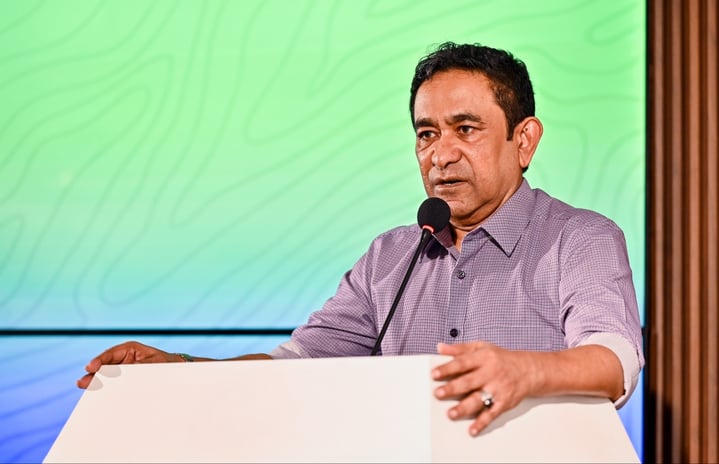
Barah MP, Ibrahim Shujau, criticized former President Abdulla Yameen for his comments that the "indefinite" detention issue could be solved in "five minutes."
Shujau said that during Yameen’s five-year administration, the former president was busy with a "five-minute card game" instead of finding a solution to the very problem he now claims is simple.
The issue of indefinite detention, where individuals are kept in pre-trial detention for extended periods without their trials concluding, creating uncertainty, once again gained public attention at a meeting President Dr Mohamed Muizzu held with the residents of Male's Maafannu ward last Thursday night.
During the meeting, a member of the public raised the issue, stating that solving the indefinite remand problem in "five minutes," as Yameen suggests, is not difficult. The person claimed that if President Muizzu instructs Home Minister Ihusan, the matter could be resolved through the police and the Prosecutor General's (PG) Office.
Responding to this narrative, MP Shujaau, a senior member of the ruling People's National Congress (PNC) and a frequent target of Yameen's criticism, extended his attack to include the last three administrations:
Shujau said that during former President Abdulla Yameen’s administration who had claimed the country’s problems could be solved “in five minutes”, even the ceiling of the Criminal Court had collapsed onto the judges.

"He spent the five minutes playing cards (a political jab at Yameen's known interest for the game). The judges in the courts were saying that this was a difficult problem to solve due to the lack of a conducive environment to work," Shujau stated.
Shujau claimed that it was former President Mohamed Nasheed (MDP) who initially introduced indefinite remand and began detaining people under this principle. He noted that the government of former President Ibrahim Mohamed Solih (MDP) not only failed to find a solution for indefinite remand but continued to arrest people under this form of detention.
Shujau concluded by emphasizing that the solution to indefinite remand is to provide the judiciary with the necessary resources and arrangements to expedite cases.
<i>Was it not the case that President Yameen, who says this can be done in five minutes, and the two presidents from the two MDP administrations could not even manage this much? By the grace of Allah, President Dr. Muizzu will solve this with good intention</i> <i>Shujau asserted</i>
Shujau highlighted that President Muizzu came to power with a pledge to resolve the indefinite remand issue. Consequently, he claims the President has now ensured a conducive environment and financial independence for judges to work, fulfilling his promise to empower the judiciary. Shujau also noted that since President Muizzu took office, some individuals held under indefinite remand have been released with monitoring tags, following laws and regulations.
In the meeting with Maafannu residents, President Muizzu clarified his inability to release the detainees unilaterally, even in "five minutes."
The President stressed that while some people may claim he could release indefinite detainees instantly, it is not his right to release individuals accused of serious crimes such as sexual abuse of minors, terrorism, murder, and drug trafficking.
"That is not something I am allowed to do. That is why it is not happening," President Muizzu said, explaining why he cannot release the detainees in five minutes.
He reiterated that the solution to the indefinite remand issue is to facilitate resources for the courts, which the government is now doing, including expanding court room capacity at the Criminal Court. However, he reaffirmed that he would not interfere by instructing the judiciary on how to handle specific matters.
To counter the popular narrative, President Muizzu released statistics on the 314 individuals currently in indefinite remand:
· Sexual Abuse of Minors: 117 people
· Drug Trafficking: 116 people
· Assault/Gang Violence: 70 people
· Murder/Homicide: 29 people
· Terrorism: 20 people
The President also noted that the "Other" categories include suspects in crimes such as theft, armed robbery, kidnapping, human trafficking, same-sex relations, arson, and smuggling.
President Muizzu concluded by stating that based on the current regulations, many of the cases currently in detention do not even fit the technical definition of "indefinite remand", and he noted that most of the detainees are now aware of their scheduled hearing dates.


