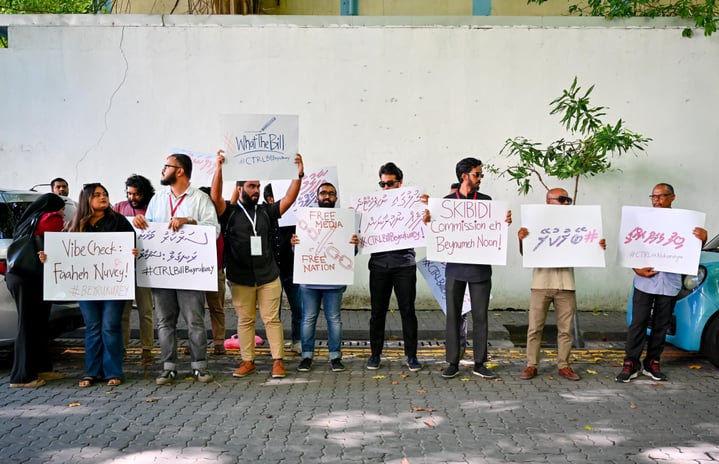
Parliament’s Committee on Independent Institutions has decided to complete its review of the contentious Media Regulation Bill by September 15.
The bill, introduced by independent member Thulhaadhoo MP Abdul Hannan AbuBakuru, was accepted in an extraordinary sitting of parliament yesterday despite widespread calls for its withdrawal.
Committee work on the bill has begun today.
The committee agreed to seek input from the Maldives Media Council (MMC), the Maldives Broadcasting Commission, the Human Rights Commission, the Youth Ministry, and registered media outlets. The committee also voted to conclude its work within two weeks, while parliament remains in recess.
Journalists have strongly opposed the bill. Media personnel protested outside the President’s Office and the Presidential Palace Mulee Aage yesterday. Several journalists were briefly detained by police before being released. Journalists are also signing a petition, stating that the legislation is designed to curtail constitutional press freedoms and demanding its withdrawal rather than amendment.
Senior journalists have also held a press conference, warning that the bill would “destroy independent media in Maldives”.
Concerns raised by journalists alleged handing excessive power to the government and weakening journalistic independence.
- Three commission members would be appointed by the President, undermining self-regulation and opening the door to government influence.
- Parliament would have the authority to dismiss members elected by the media.
- A code of conduct requiring journalists to elected governments could hinder them from holding the government accountable.
- The commission would have power to suspend licences while cases are under investigation and to indefinitely shut down outlets. Courts would also be able to revoke licences.
- The commission could enter newspaper and TV offices with police if issues are deemed threats to national security. The term national security is defined very vaguely.
- Individual journalists could face actions, which is not included in the current system, raising fears it will deter reporting.
- Journalists would be required to issue apologies for “false information”, although the bill does not define who or what determines accuracy.
- Article 60 extends the bill’s provisions to social media, applying the same rules governing newspapers to digital platforms.


