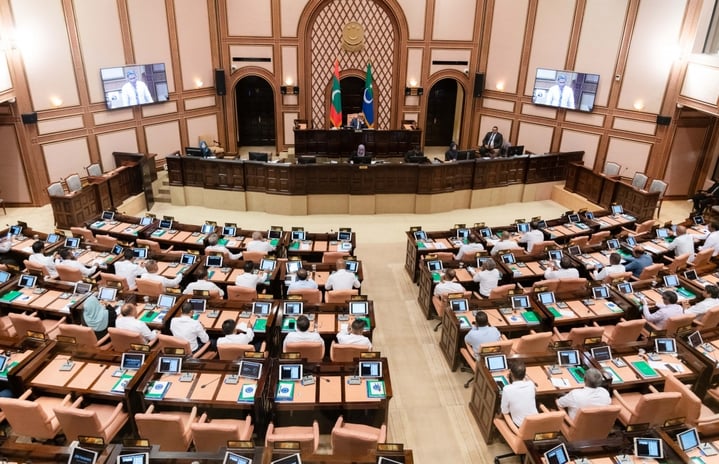
In today's parliamentary debate on amendments to the Judges Act, MPs from ruling People's National Congress (PNC) and opposition Maldivian Democratic Party (MDP) exchanged accusations of judicial interference.
The bill proposing amendments to the Judges Act was submitted by PNC MP Saudhulla Hilmy (North Thinadhoo) on behalf of the government.
During today’s debate, MDP MP Mauroof Zakir (Kendhoo) claimed the bill’s primary aim is to exert control over the judiciary.
Mauroof claimed the bill's intent is evident—bringing Chief Judges of all court levels under direct government influence.
MP Mauroof argued that the government has no place influencing a judge’s conduct beyond the courtroom. He added that the delivery of justice is hindered not only by judges but also by valid concerns over limited space, outdated laws, and procedural shortcomings.
He said that the Civil Procedures Act is one reason for delays in justice being served, adding that the Act has led to numerous cases remaining pending at the Civil Court.
Mauroof asserted that any amendments to the Judges Act must be made in a way that guarantees justice.
"In reality, the presiding judge changes every other day. There aren't enough judges in the courts. There isn't sufficient space in the courts. It is wrong to think that justice can be served through controlling judges," he said.
He further claimed the bill is designed to strip judges of their pension entitlements and restrict their ability to pursue certain livelihoods after leaving the bench.
Although regulations on courts are historically made through consultations with judges, this bill gives the powers to the Judicial Services Commission, he said, adding that it is wrong to decide on limitations on judges' conduct without their input.
PNC's MP Saudhulla Ali, who submitted the bill, said that delays in justice are one of the most prevalent concerns in Maldivian society, with some cases failing to be concluded even in three to four years.
He said that each Civil Court judge has three to four hundred pending cases, with it sometimes taking up to six months between hearings. Due to this, it is imperative to find a solution even if through changes to the law, he maintained.
North Henveiru MP Ahmed Aifan stated that despite campaigning on judicial reform, the MDP ultimately damaged the judiciary during their time in office.
He accused the MDP of having appointed political persons to the JSC as well, which led to judges being in fear of decisions the JSC may make.
"At the time, judges did not know how to deliver a sentence without having the JSC accuse them of ethical breaches. The past five years have gone by with judges in fear of what the JSC may do, leaving them unable to deliver a just verdict in many cases. That is the condition the justice system was in," Aifan said.
As per the proposed bill, judges who step down or are dismissed may not appear as lawyers in courts they served in over the previous three years, for two years after leaving office.
Even after the two-year restriction period, former judges are barred from representing clients in any case where they previously presided as a judge and a conflict of interest exists
The bill states that in addition to what is defined as permissible for judges, there are no reservations to judges engaging in activities that the Judicial Service Commission (JSC) deems will not affect judges' duties, impartiality and independence.
Judges are prohibited from holding other state roles, engaging in private sector work, or accepting contract-based employment.
The bill further states that while judges can participate in funds run by the State for regular employees, they cannot create or manage funds. The bill also states that judges cannot conduct securities businesses under the Financial Securities Act and regulations, conduct trading on the stock exchange or run law firms.
The bill states that judges must not run any form of business, nor should they purchase or rent State properties. Judges are also barred from any direct or indirect involvement in any transaction between the State and other parties.


