Judicial Service Commission (JSC)'s President Hussain Riza has defended the commission's decision to recommend the removal of Supreme Court judges Dr. Azmiralda Zahir and Mahaz Ali Zahir after its investigation into the two justices.
This comes after the parliament's Counsel General Fathimath Filza provided legal advice to the parliament saying the commission had not followed the necessary procedure.
In her recommendation to the committee, Filza said the JSC had violated the principle of equal treatment for all guaranteed by the Constitution and the law by acting differently in deciding cases submitted to the commission regarding judges.
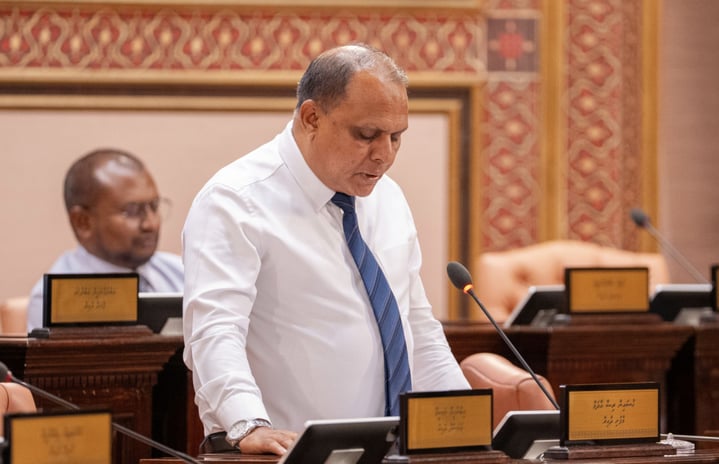
Debating the JSC's motion on the dismissal of the two judges, Riza, who is also the MP for Maafushi constituency, defended the JSC's actions in conducting the investigation.
He said Filza’s statement; that only the committee responsible for deciding whether to investigate a case has the authority to do so, was based on a misinterpretation of the law. According to him, the Judicial Service Commission (JSC) Act grants the full commission the authority to determine whether or not to proceed with cases involving judges. He cited Article 23(a) of the Act, which states that either a committee or the commission may decide to investigate a case, thereby confirming that the commission as a whole has the legal discretion to initiate investigations. He added that the commission’s decision to investigate the case involving the two justices was made in accordance with the powers granted by law.
Even if it is considered that procedures were not followed for the sake of argument, Riza claimed it would not infringe on the rights of any of the judges. He went onto say that higher courts had previously determined that the outcome of the case would not change if a fundamental right was not violated by not completing a certain procedure.
JSC had also set a precedent in the past by deciding to probe into cases without the involvement of a smaller committee, he said. Riza took the example of the commission's decision to summon former Chief Judge of the Criminal Court Ahmed Hailam to the committee over a message sent to the court's WhatsApp group. The decision was made in a meeting of the commission.
"You have to look at all these angles, you have to look at the judgments of the Supreme Court and the High Court. I don't believe that the Councilor General should issue such a [recommendation] without looking at the general practice," Riza said.
"The [recommendation] should have been issued more thoughtfully. The result of issuing such wrong policies is corruption within the country. This is the spread of wrong information within the society. So my hope is that the Counsel General becomes more responsible than this."
In the report sent to the parliament floor by the judiciary committee said JSC took the initiative to investigate the case based on information received by an individual. It also said that it was evident from Article 23 of the JSC Act that the commission has the authority to make that decision.
It was written that Article 22 of the Act gives JSC the authority to investigate cases even when the decision making committee decides against investigating a case, adding that the committee did not believe there were procedural issues in the process of investigating the matter.
Both judges asked for an opportunity to appear in parliament to share their concerns, saying the case was investigated in violation of regulations. The Bar Council has also requested an opportunity to appear before the committee to share its concerns. However, the committee decided against it.


