Two new cases of filariasis have been confirmed in Haa Dhaalu Atoll Kulhudhuffushi.
A screening test conducted during a health camp for expatriates living in the island city on the first and second days of this month, to mark World Aids Day, revealed that 17 people were diagnosed with filariasis, which has been declared eradicated from the Maldives.
Those in contact with the migrant workers were tested.
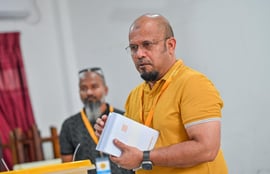
Finance executive Mohamed Moosa, who is temporarily in charge of Kulhudhuffushi Regional Hospital, said that two more people had tested positive for filariasis in subsequent antigen tests. Therefore, 19 patients are currently undergoing treatment, he said.
Indian expatriate workers were infected with the virus. All of them were employees of two companies who had recently gone to the island for construction work. Later, the two people who tested positive were also two Indians who were with them.
"Although 19 patients with filariasis are currently being treated, there is no community spread on the island," Mohamed said.
The Health Protection Agency (HPA) said that 500 kits have been sent to Kulhudhuffushi for testing for filariasis. The work is expected to begin this week.
Filariasis is transmitted by the Culex mosquito, which breeds in dirty stagnant water. If the Culex mosquito bites a person with filariasis and then bites another person, the chances of developing filariasis increase. However, even a single mosquito bite may not cause filariasis.
A patient may be asymptomatic for several days after getting infected. However, after a long period of time, symptoms such as skin exfoliation and limb swelling a condition known as elephantiasis. Kulhudhuffushi Hospital said that none of the people on the island showed external symptoms of the illness.