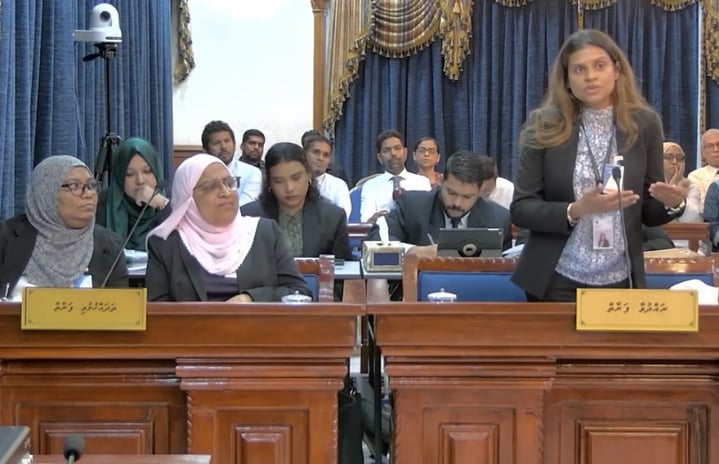
Parliament Secretariat stated in Supreme Court today that the Parliament Regulations stipulate that only the Deputy Speaker can preside over a parliament sitting concerning a no-confidence motion against the Speaker, and that to act in any other way would first require the regulations to be revised as such.
The statement was made by parliament's Counsel General Fathimath Filza in response to questions put forth by the Supreme Court bench presiding over the case against parliament submitted by Maldivian Democratic Party (MDP).
The case was submitted following repeated attempts in vain to hold a sitting on the party's no-confidence motion against Parliament Speaker Mohamed Nasheed. All the scheduled sittings were cancelled by the Parliament Secretariat citing regulations due to Deputy Speaker Eva Abdulla's absence owing to being on sick leave.
Judge HusnuSuood asked what the process is in other countries, bearing in mind that Article 44 of the Parliament Regulations state that one of five longest serving parliamentarians can preside over a sitting in the absence of the Speaker and the Deputy Speaker.
In response, Filza stated that similar to the Maldives Constitution, other countries also do not stipulate that a specific person has to preside over matters of no confidence against a Parliament Speaker.
However, Filza emphasized that she believed the parliament had a specific intention in stipulating a certain person preside over a no-confidence motion against the Speaker when Article 82 of the Constitution prohibits the Majlis Speaker from presiding over a matter of his own no-confidence, and removes any risk of conflict of interest.
"...(The Regulations) specify that it must be the Deputy Speaker. A no-confidence motion against the Speaker is the biggest case that can be presented in a parliament term. Therefore, owing to the importance given to this matter, the motion will be presided over by the next most key officer of the parliament," Filza said.
The Counsel General maintained that she did not believe the Secretariat could raise a common procedural matter and come to a different decision when the Regulations are clearly laid out.
Judge HusnuSuood proceeded to ask of Filza what she believed was the solution in the case when a Speaker or Deputy Speaker willfully refuses to attend sessions, thereby sending the institution into a deadlock.
Filza responded by dismissing MDP's claims that other parliamentary work could not be allowed to proceed without first deciding on the matter of Speaker's no-confidence, stating that she did not believe that any such limitations were presented.
She said that she held this view because the matter of no-confidence had not yet been submitted to the parliament floor as is required by the Regulations.
"We will need to bring an amendment to the Regulations. We have already proposed this," she explained as a solution to removing a parliamentary deadlock.
Attorney General's Office appealed at this hearing to issue an order that the interpretation of the Parliament Regulations that allow a halt to the institution's proceeding is incorrect.


