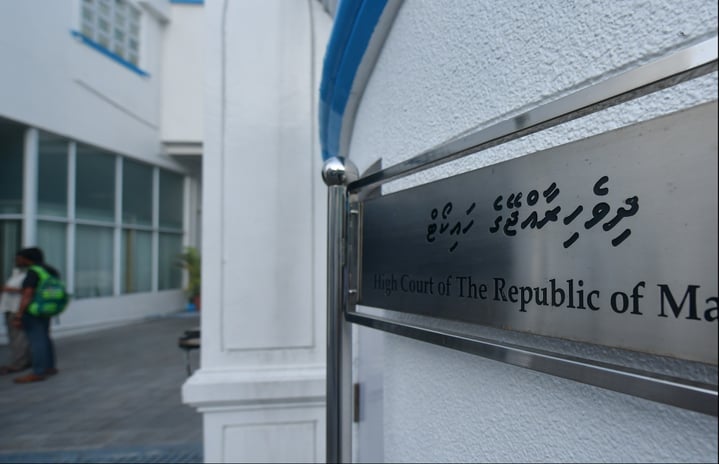
The High Court, on Saturday, issued a verdict asserting that DNA evidence on paternity was inadmissible, despite section 411(c) of the Maldives Penal Code listing it as legitimate evidence.
Citing the lack of testimony by four male witnesses, the court decided to maintain a ruling finalised by the Kudahuvadhoo Magistrate Court in 2017 over a case of unlawful sexual intercourse. The initial ruling, which was issued in reference to 411(a) and 411(c) of the Penal Code, was appealed by the Prosecutor General's Office.
As per the High Court, the charge of unlawful sexual intercourse could not be proven against the defendant, Mohamed Thaufeeq, on the basis of a woman's testimony and DNA evidence.
However, section 411(c) of the Maldives Penal Code states that, "if the offense in subsection (a) is proven with comparably persuasive evidence other than the testimony of four witnesses, such as DNA evidence or evidence of pregnancy, the offense is one grade lower than it would otherwise be".
Despite highlighting that the classification of the action as a misdemeanor or felony would be downgraded by one level if four witnesses did not provide testimony, the aforementioned provision describes DNA evidence as 'comparably persuasive evidence' which can be utilised in proving the charge under 411(a), which concerns unlawful sexual intercourse.
DNA analysis results are also accepted in other courts of law in Maldives, including during murder trial proceedings.
The court also attributed the decision to dismiss the DNA evidence to the Maldivian Fatwa Committee's view that it was prohibited to conduct DNA tests to ascertain the paternity of children born out of wedlock.
At present, the Maldivian Fatwa Committee does not have any legal jurisdiction over matters of legislation.
Although Thaufeeq continues to deny committing adultery, Fathmath Shameema asserts that he is the father of the child she gave birth to on April 13, 2016.
Her claim was subsequently corroborated through a DNA analysis which found that the child's DNA is a match for Thaufeeq.
Highlighting that the child was born within a year of Shameema's divorce on December 21, 2015, the verdict noted that one year within divorce or the death of the husband was the maximum period within which a child's paternity can be confirmed.
Therefore, the High Court asserted that the child, confirmed via DNA analysis to be Thaufeeq's offspring, must instead be legally considered the child of Shameema's former husband.
The verdict went on to stress the importance of the verdict to the child and noted the detriments of false paternity assignment.
The judges bench presiding over the case comprised of Abdulla Hameed, Ali Sameer and Mohamed Faisal.
The High Court's verdict has prompted widespread public criticism and discourse.
Notably Ahmed Shaheed, former Foreign Minister and current United Nations Special Rapporteur on Freedom of Religion or Belief, expressed concern that the ruling would lead to increased impunity for sexual offenders in Maldives.
In line with Shaheed's sentiments, former Minister of State for Health Dunya Maumoon highlighted that DNA evidence is currently accepted by several Muslim countries across the world.
Since the beginning of the year, public ire has grown considerably over the government's meagre record of arresting and convicting sexual offenders, despite numerous pledges made to "protect the rights of children and women".
Protesters demanding justice for rape and sexual assault victims held demonstrations during June and July in front of Ministry of Gender, Family and Social Services as well as the roads of capital Male', following an upsurge of reported cases and alleged misconduct of police during investigations.


