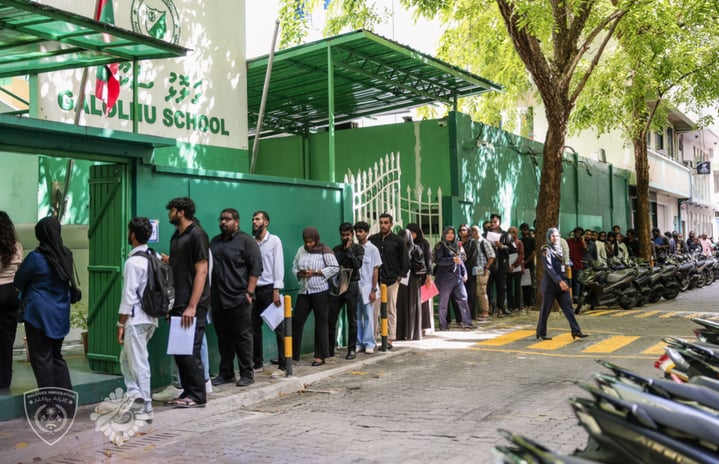
Across the blue archipelagos of the Maldives, an extraordinary economic paradox plays out daily. Theoretically, the nation’s economy is booming, driven by record-breaking resort developments and sprawling urban infrastructure. Yet, while hundreds of thousands of jobs go begging, local youth line up hundreds deep for desk jobs, leaving the country heavily reliant on imported foreign labor to keep its core industries alive.
According to data from the Maldives Bureau of Statistics (Census 2022), while overall national unemployment stands at a moderate 3.3 percent – 4.6 percent, youth unemployment (ages 18–24) hovers between 12 percent and 16 percent, more than three times the national average. Meanwhile, nearly 29 percent of youth overall and over 40 percent of young women remain Not in Employment, Education, or Training (NEET).
This disconnect is not caused by a shortage of available work, but by a widening friction between youth career aspirations and actual job market demand.
Graduates & workforce transition
Over the past five years, an estimated 6,000 to 8,000 students have completed secondary education (O-Levels and A-Levels) annually across Maldivian schools. However, data from the Maldives Bureau of Statistics Education Status Census Report highlights a critical bottleneck in how these graduates transition into the economy:
- Low direct workforce entry in essential sectors: Out of the resident Maldivian population aged 15 and above, 60.9 percent are employed, 3.3 percent are unemployed, and 35.8 percent remain outside the labor force.
- The school-to-work delay: Labor Force Participation Rates (LFPR) for the 15–19 age group remain under 20 percent, as the vast majority of school leavers either wait for entry-level administrative positions in Malé or pursue general higher education degrees rather than technical or vocational trades.
- Higher education output vs. market need: While thousands of tertiary graduates complete diplomas and bachelor's degrees annually in business administration, HR, and general management, fewer than 5 percent of college graduates hold qualifications in technical fields, marine engineering, commercial agriculture, or vocational crafts, the precise sectors facing acute labor shortages.
Classroom to cubicle: How mindsets are formed
The roots of this labor chasm lie deep within households and classrooms. From an early age, parents and schools systematically steer children toward a narrow definition of success: white-collar office positions, public administration, and desk roles in Greater Malé.
Rather than preparing children for what an island economy actually depends on, society inadvertently instills a damaging hierarchy of labor from primary school onward:
- The "Ideal" Track: Academic excellence is framed as an exit ticket away from physical labor. Government and civil service roles carry immense cultural prestige, job stability, structured hours, and proximity to family. The intense competition for these roles underscores the appetite: a recent call for 50 Immigration Officer Trainees drew an astounding 876 applicants.
- The "Lesser" Track: Fieldwork, commercial fishing, agriculture, and blue-collar trades are subtly painted as callings meant only for the "less educated" or "less privileged".
By the time young Maldivians finish school, many have internalized the prejudice that physical labor or entry-level service work is beneath them. This ingrained stigma breeds a culture where holding out for a rare desk job, or remaining idle, is socially preferred over taking up essential trade, resort, or technical positions.
Preferred paths vs. economic realities
This sharp divide between youth aspirations and economic necessity highlights a profound structural mismatch in the Maldivian labor market. On one side stand the cultural aspirations of young job seekers, who overwhelmingly seek urban office roles, desk-bound administrative work, and comfortable public sector or civil service positions based in Greater Malé.
On the other side lies the actual market demand dictated by the nation's core economic growth drivers. Industries like tourism and hospitality require front-line resort staff willing to endure shift work, long customer-service hours, and full-time residency in staff quarters on distant islands. Similarly, the construction and engineering sectors demand rigorous manual and technical field operations , while fisheries, marine technology, and commercial agriculture require physical endurance and long stretches of isolation from urban hubs.
Because local job seekers frequently resist island relocation, living in shared staff quarters, or engaging in field labor due to social stigma and geographical isolation, private employers face severe domestic recruitment shortfalls, forcing the national economy to rely heavily on foreign labor to bridge the gap.
The shift to expatriate dependency
Faced with a domestic workforce unwilling or unqualified to fill these roles, employers have turned massively to foreign labor.
According to the Maldives Bureau of Statistics International Labour Day Release:
- Foreign workers account for over 32 percent of the total working-age population (130,088 foreign residents out of 411,219).
- Expatriate labor participation rates exceed 97 percent – 99.4 percent, compared to 64.2 percent for resident Maldivians.
- Construction & Technical Trades: Expatriates comprise 65 percent to 75 percent of the sector's total workforce.
- Resort Operations: Only about 33 percent to 35 percent of resort employees are Maldivian nationals, with foreign workers comprising the remaining ~65 percent to 67 percent.
Workforce composition in key sectors:
Construction & trades 25-35% 65-75%
Resort operations 33-35% 65-67%
Public administration High Very Low
This reliance creates a self-perpetuating cycle; as businesses rely on ready-made foreign labor, entry-level local training programs shrink, further widening the practical skills gap for the next generation.
Re-engineering the economic backbone
Fixing this structural imbalance requires overhauling how young minds are taught to view productive work:
- Realigning curriculum with economic reality: Schools must teach children how the Maldivian economy actually operates. Curriculum should champion sustainable fisheries, marine engineering, renewable energy technology, and modern resort management as vital, high-value fields powering the nation.
- De-stigmatizing blue-collar careers: Parents and educators must actively dismantle the myth that trade skills represent personal failure. Hands-on vocational pathways must be celebrated alongside academic degrees through early exposure and paid apprenticeships.
- Upgrading trade conditions & pay: Industry leaders must complement mindset shifts with fair entry-level wage baselines and clear career progression, ensuring young locals see technical trades as viable, long-term careers.
Until the education system and parenting culture stop conditioning youth to look down on the very industries that keep the country afloat, the Maldives will continue exporting its youth potential while importing its economic backbone.


