
The digital world is no longer a space today’s generation can opt into or avoid. It is woven into daily life, and children are exposed to digital technology from their earliest years.
While for today’s adults this may be a hard to imagine concept, having been introduced to the digital era much later in life, it is today’s reality that the digital world is an integral part of a child’s life.
UNICEF Maldives maps the new realities of growing up online in a report titled "Building Futures: Growing Up in Maldives in the Digital Age”, which addresses how digital environments shape childhood in Maldives. The report highlights four objectives: digital equity, digital citizenship, digital safety, and digital wellbeing. With a comprehensive study of how the situation stands in the Maldives, the report goes on to propose an agenda for action for families and caregivers, schools and communities, laws and regulations, and platforms and service providers to ensure children are supported to navigate digital spaces safely as they grow.
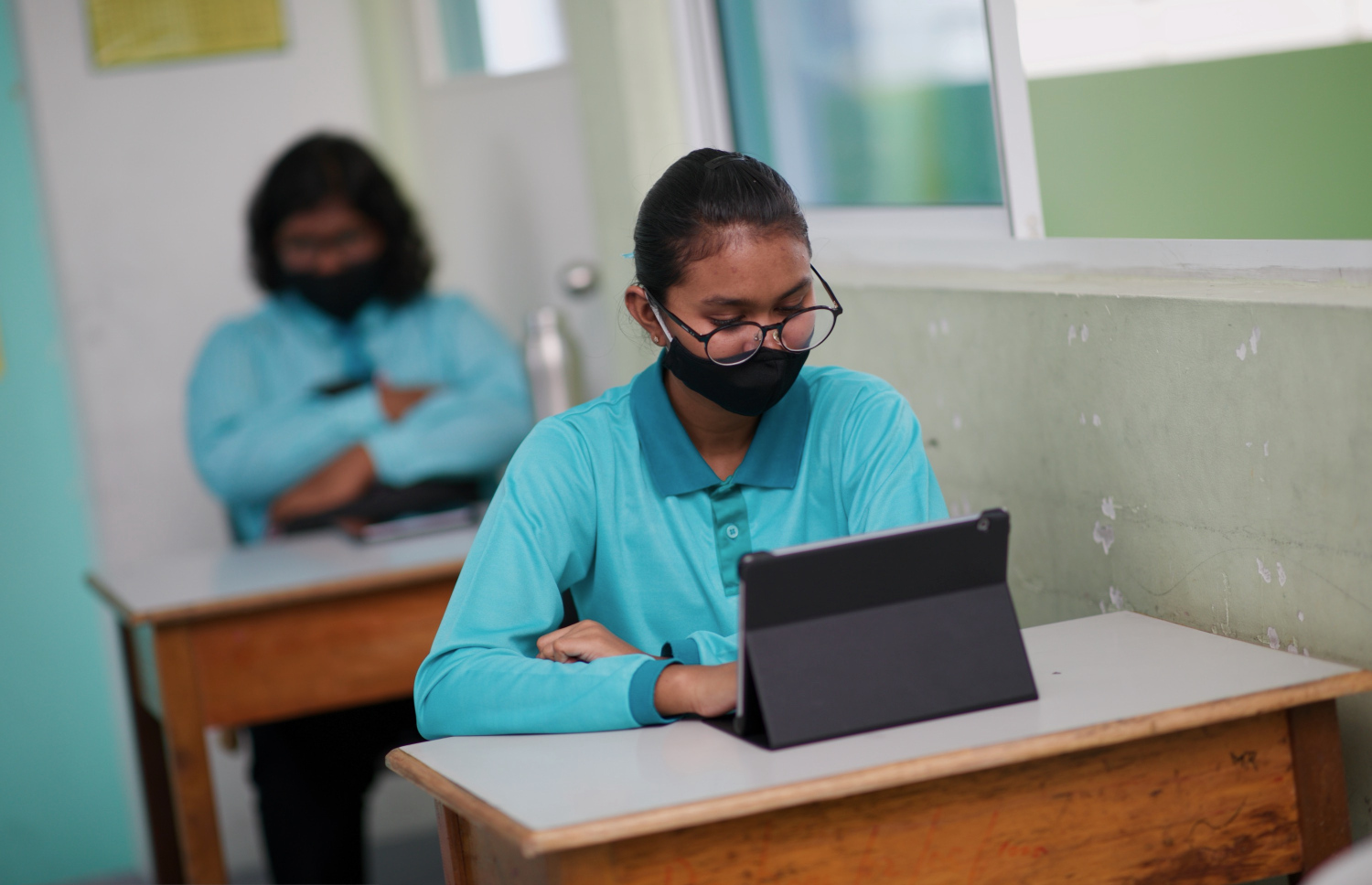
The report elaborates on what the four objectives cover:
Digital Equity: Whether children are able to participate in digital environments on fair and meaningful terms
Digital Citizenship: Whether children are supported to engage critically, responsibly, and as rights-aware participants in digital spaces
Digital Safety: Whether children are protected from harm in digital spaces
Digital Wellbeing: Whether digital environments support rather than undermine healthy development.
From Toddler to Teen: The Shifting Online Use and Risks
Maldives has approximately 119,159 children aged 0 to 17 living across 130 inhabited islands, accounting for 31 percent of the total population, as per the 2022 Census. Digital exposure varies across ages, as well as geographical locations, owing to access and other factors.
The report emphasizes that while digital exposure is not inherently bad, with several ways in which it contributes to healthy development, the risks are amplified when taking into account the absence of safeguards, unregulated access, lack of adequate supervision and regulation, quality of content, and other factors.
The digital universe is designed by adults with child safety not high on their list of priorities. This creates a world that poses several dangers to a child navigating the sphere without appropriate safety measures, such as exposure to online grooming, cyberbullying, inappropriate material, manipulative algorithms and targeted commercial advertising, and screen addiction.
Risk is not limited to what children see, but includes how they interact, how others engage with them, and how digital systems are structured, the report points out.
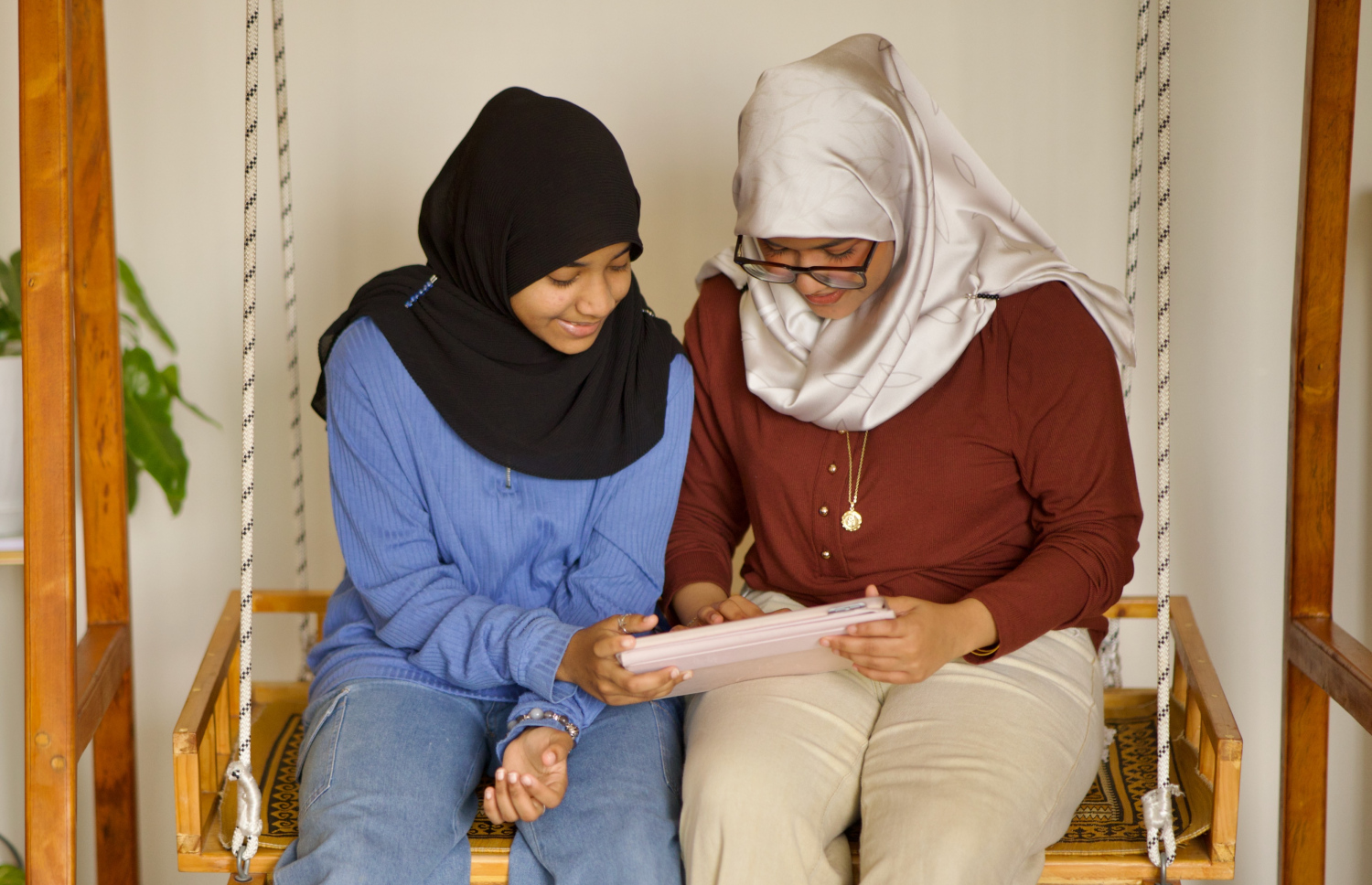
The United Nations Committee on the Rights of the Child define 4Cs, set out by the General Comment No. 25 , which helps to understand the main types of risks children may encounter in digital environments:
1. Content risks: exposure to harmful or inappropriate material such as violence, sexual content or misinformation
2. Contact risks: harmful interactions with others, including grooming, exploitation and cyberbullying
3. Conduct risks: children’s own behaviour online, such as excessive screen time, sharing personal information or engaging in risky interactions
4. Contract risks: exploitation through platform design, data collection, targeted advertising and manipulative features
These show that risk is not limited to what children see, but includes how they interact, how others engage with them, and how digital systems are structured.
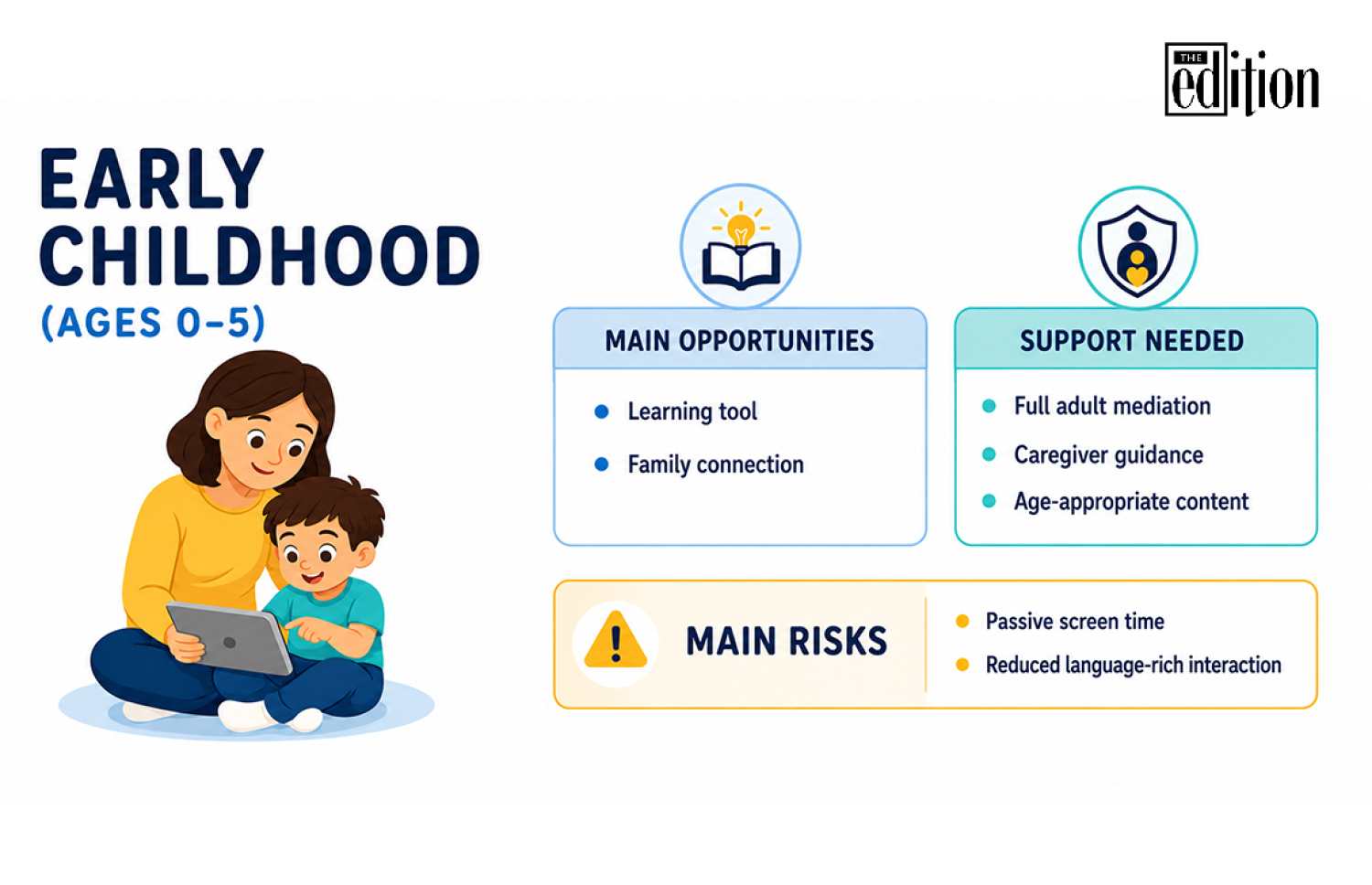
In early childhood, content risk dominates through passive screen exposure.
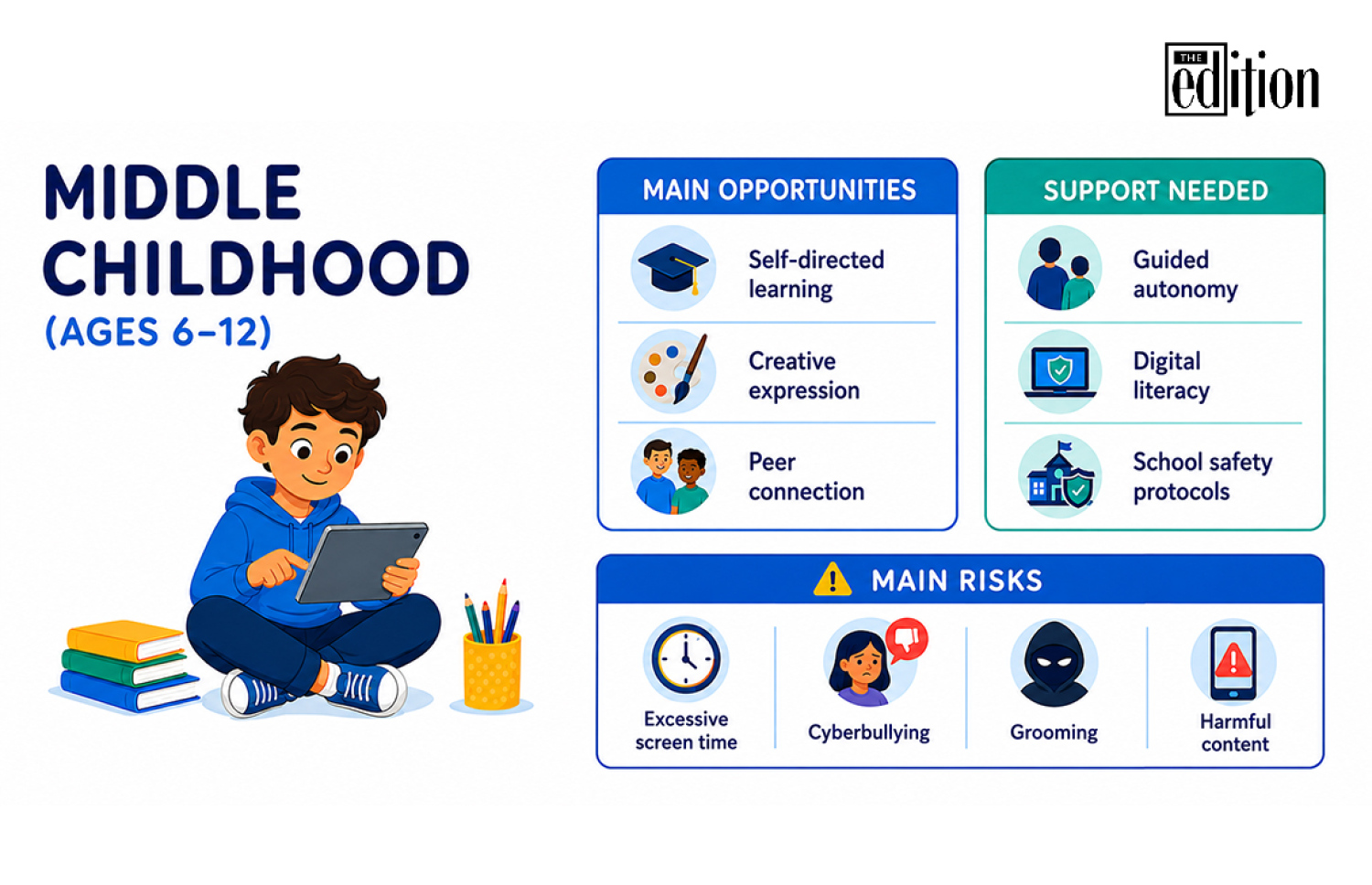
In middle childhood, contact and conduct risks grow as children interact directly with peers and platforms online.
In adolescence, contract risk becomes more significant as data-driven systems, targeted content and commercial incentives shape identity, behaviour and participation.
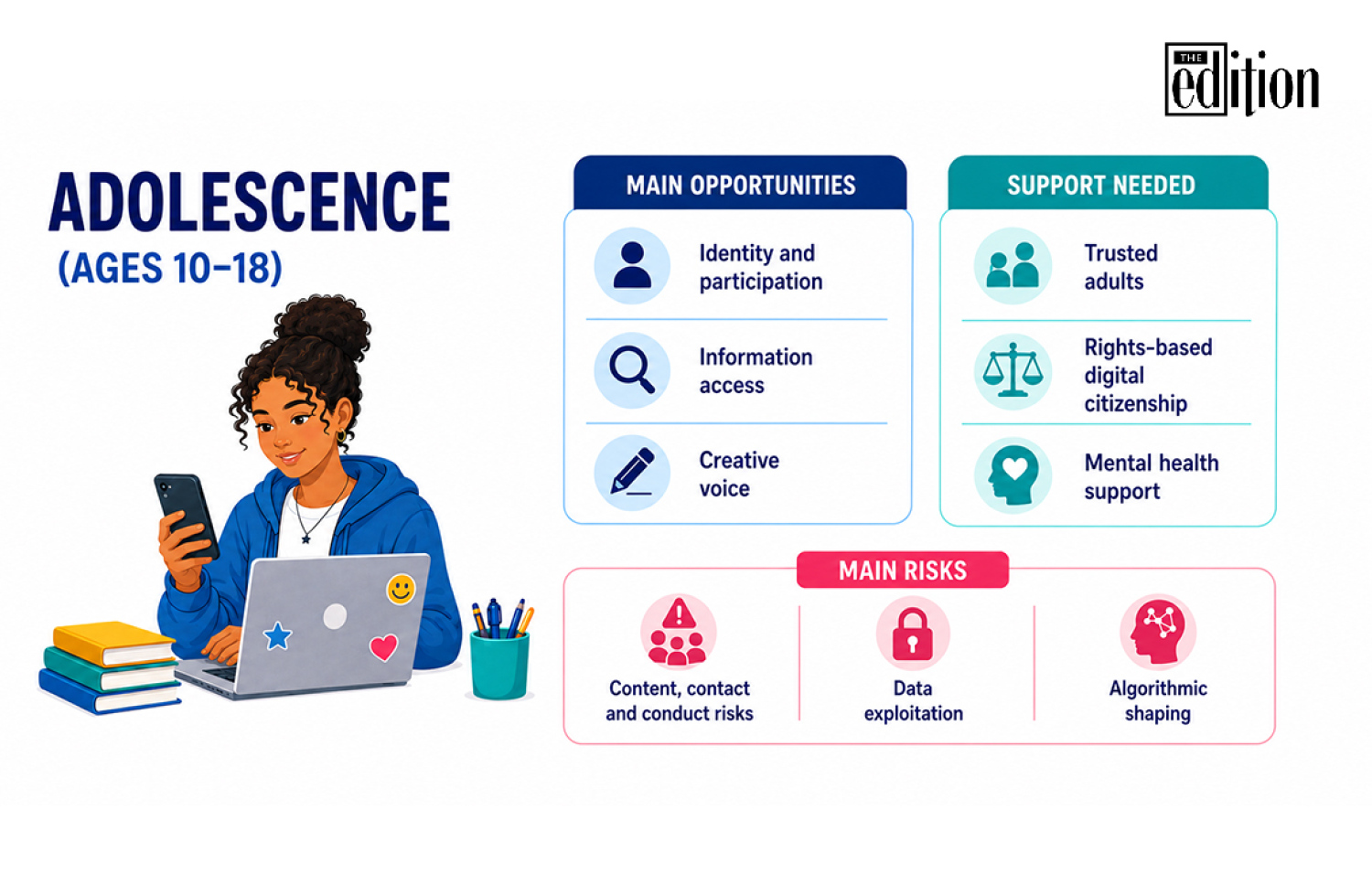
Children move through a digital development arc, from full adult mediation to guided autonomy and ultimately to responsible digital citizenship. UNICEF stresses that systems surrounding children must evolve in step, ensuring their online experiences promote wellbeing, protect mental health, and support meaningful participation.
Building Safer Digital Worlds for Every Child
Children’s digital experiences arise from a connected ecosystem of families, schools, communities, laws and platforms. A socioecological approach emphasizes shared responsibility and coordinated action across these levels, the report states. Aligning systems with children’s developmental needs ensures digital equity, safety, wellbeing and meaningful participation – guided by children’s own voices.
The report suggests actions for various concerned actors.
Families and caregivers
Families must support children’s digital development from early mediation to adolescent guidance, while building healthy routines and equitable access to advice.
Parental controls should be paired with open, age-appropriate conversations so that children see these measures as protective rather than punitive. Digital childhood guidance should be embedded in early childhood development and antenatal services, ensuring parents receive support before children first encounter screens.
Families also need help establishing healthy digital routines around sleep, play, movement, communication and emotional wellbeing, so that screen use does not displace the relationships and activities essential for development.
Schools and communities
Schools play a critical role across the entire developmental continuum, serving as the front line for learning, participation, wellbeing and early detection. Digital citizenship should be embedded throughout the curriculum, with age-appropriate content aligned to developmental stages and the risks posed.
Healthy, holistic schooling requires positioning schools as safe environments for child and adolescent mental health – integrating social and emotional learning, early identification, counselling, family engagement and timely responses to digital stress. Clear school-level protocols are essential, as is sustained teacher training, covering digital pedagogy, digital citizenship, early detection of digital distress and referral pathways, across all childhood stages.
Legislative and regulatory systems
Legal frameworks form the structural foundation for every other part of the digital safety ecosystem. Without enforceable standards, guidance from families and schools lacks institutional support, and platform accountability remains voluntary. Regulation must therefore go beyond reacting to harm – it must set the conditions for safe, equitable and developmentally appropriate digital environments for every child.
This includes enacting comprehensive child online protection legislation covering data protection, age-appropriate design, grooming and exploitation, image-based abuse and platform responsibility. A cross-ministerial coordination mechanism should oversee children’s digital wellbeing, supported by shared data systems, clear referral pathways and joint accountability.
Children’s voices must be embedded as a design requirement in all future digital policy, and legal standards must address accessibility, inclusion and fairness.
Platform and service provider accountability
Platforms are the architects of children’s digital environments. They must be held to child-rights standards across the full product lifecycle, rather than relying solely on safety features added after harm occurs. This includes designing digital spaces that are safe, fair, age-appropriate and supportive of children’s wellbeing.
Child-centred design should be the default for any service children are likely to use: strong privacy settings, age-appropriate content, accessible reporting tools and the absence of manipulative design. Clear standards are also needed for AI systems used with children, ensuring transparency, minimal data collection and protection from exploitative personalization.
Telecom providers must work alongside platforms to deliver affordable, safe connectivity across the Maldives, with child-protection requirements built into service agreements. Safety should be treated as a basic service standard, and not an optional or premium feature.

Children move through a single digital developmental continuum – from early screen mediation to growing independence and adolescent identity-building. Systems that fail to recognize this continuity will miss children at every stage, the report stresses.
Coordinated action is essential to close the widening gap between children’s digital immersion and the capacity of institutions to support them. With strong leadership, effective detection and response systems, child-centred regulation and investment in digital literacy and mental health, Maldives can build a digital ecosystem grounded in equity, citizenship, wellbeing and safety.
Three recommendations stand out in the UNICEF report:
- Treat digital childhood as a whole-of-government priority
- Build a functioning detection and response chain for early, effective support
- Hold platforms to child-rights standards so digital environments promote dignity, inclusion and healthy development


