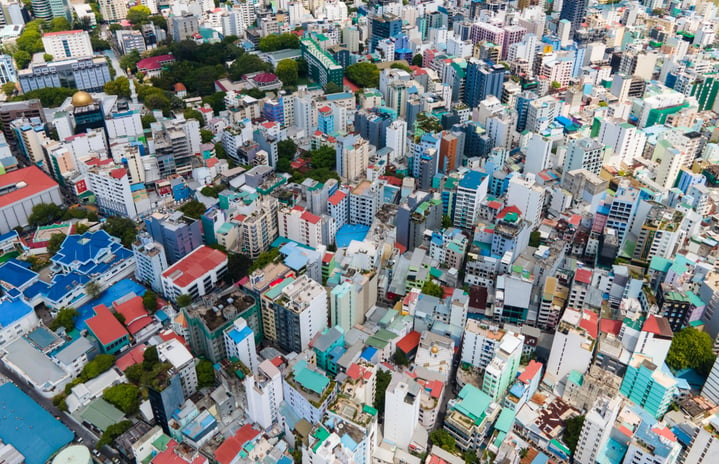
From the air-conditioned hotaas to park benches, one of the world's most densely packed capital is running out of spaces that aren't home or work.
Imagine a space in Male’ where you can sit for two hours without ordering a single item. A place where you can stretch your legs, feel a cool breeze that doesn't cost MVR 80 an hour in air conditioning, and where nobody is eyeing your empty glass with the thinly veiled hospitality of a landlord calculating square-footage yield.
If that sounds like a total fantasy or a half-forgotten memory from a generation ago, you are experiencing the claustrophobic reality of modern urban life in Maldives. You are witnessing the extinction of the "Third Place."
Coined by urban sociologist Ray Oldenburg, the concept is beautifully simple: your first place is home. Your second place is work. Your third place is the social anchor of community life. These are the affordable cafes, neighborhood squares, public parks, and community hubs where people gather to talk, unwind, and exist outside the domestic pressures of family and the demands of employment.
Historically, third places were the foundation of Maldivian society. But in an island capital where everything under the sun is squeezed into just over eight square kilometers, the third place isn’t just dying. It has been systematically priced out, built over, and commercialized out of existence.
From the Traditional Hotaa to the MVR 70 Cappucino
To understand what we’ve lost, you only have to look at the changing face of Maldivian caffeine culture. Long before specialty coffee houses arrived, the ultimate Maldivian third place was the local cafe’ or sai hotaa.
The hotaa was a radical economic leveler. It didn't matter if you were a civil servant, a brew fresh off a fishing vessel, or a construction worker; everyone sat on the same plastic chairs, drank the same MVR 3 kalhu sai (black tea), and shared plates of hedhikaa (short eats). You could argue about football, debate politics, or simply watch the motorbikes stream down the road for hours. The hotaa was a living room for a public that didn't have room at home.
But the brutal math of Male’’s commercial real estate market put an end to that. As old plots were redeveloped into multi-story residential towers, ground-floor rents skyrocketed. For a business to survive a monthly rent of MVR 40,000 to MVR 60,000, the low margin, slow model of the traditional hotaa became economic suicide.
Enter the specialty cafe’ era. While spaces like Meraki, Civil Coffee Society, and The Family Room revolutionized our appreciation for freshly roasted beans, they also fundamentally altered the social contract of hanging out. The modern aesthetic; minimalist timber, polished concrete, and limited seating, is a masterclass in modern table turnover.
The economics of running a space where people just sit and talk don't add up anymore. If a group occupying a four-person table only orders a couple drinks and a side over three hours, these cafe’s end up losing money. It is awful, but landlords don't accept rent in community spirit.
As a result, socializing has become a transactional sport. To meet a friend means to spend money. If you want a comfortable seat and functioning air conditioning to escape the sweltering heat, you must pay a "Loneliness Tax" disguised as a premium pour-over.
The Geography of Claustrophobia
The loss of the third place hits incredibly hard in Maldives due to the unique crisis of our first places.
With thousands of people packed into tiny apartments where three generations often share a single flat, "home" is rarely a sanctuary of quiet relaxation. In a high-density environment, public space serves as a relief valve. When home is loud and work is stressful, you desperately need a neutral middle ground to clear your head.
Yet, outside the commercial cafes, where exactly do you go?
Male’ has notoriously few green spaces. Sultan Park remains a beautiful oasis of vegetation, but its historic royal layout doesn't function as an open civic square. Lonuziyaaraiy Park and other small neighborhood pockets are often tiny clearings squeezed between high-rises.
Even our public waterfronts- the ultimate democratic spaces, have changed. While Artificial Beach and Rasfannu offer a rare glimpse of open horizon, they are intensely commercialized, flanked by fast-food outlets, or heavily monitored. Try sitting on a bench for too long without moving, and the sensory overload of roaring exhaust pipes, bright signs, and shifting crowds will push you along anyway.
We are left with an island that is less a community and more a machine for sleeping, commuting, and spending.
Hulhumale’: The Promised Land or Just a Wider Maze?
When the reclamation of Hulhumale’ began, it was pitched as the antidote to Male’’s urban ills. A master plan paradise with wide avenues, designated green belts, and deliberate, spacious public parks. To an extent, Hulhumale’ Phase 1 delivered. Hulhumale’ Central Park became a massive hub where families sit on mats, kids ride bicycles, and friends meet to jog.
Yet, as Hulhumale’ Phase 2 rapidly shoots up with high rise social housing towers, the familiar economic pressures of the capital are spilling over. With the rising population of the area, it has quickly mirrored the hustle and bustle of Male’, having to drive around until you find an available outdoor bench on the beach or a seat in a cozy little cafe’.
Reclaiming the Island Living Room
The societal impact of losing these free spaces isn't just a matter of convenience; it’s a public health crisis. The mental health strain of living in a hyper-dense concrete grid without an escape hatch is well documented. When you destroy the places where people naturally bump into each other, you break down the informal social safety nets that make a neighborhood feel safe and cohesive.
If you have to pay MVR 100 every time you want to see a friend, you stop seeing them as often. Social isolation grows, hidden away behind the closed doors of multi-story concrete blocks.
Can we bring the third place back? It requires looking at urban planning through a lens that values human happiness over maximum commercial yield. We need public policy that mandates the inclusion of non-commercial, sheltered social spaces, shaded public seating, community-managed multi-use rooms, and small, green neighborhood squares where sitting down does not warrant opening wallets.
Until we intentionally design spaces that welcome people to simply be, Male’ will continue to feel smaller and more expensive by the day. So, the next time you find a quiet corner in a cafe’ where the barista doesn't clear your glass the second it’s empty, or a public bench under a rare banyan tree that actually catches the sea breeze- hold onto it. You aren't just taking a break; you are occupying a vital, sparse piece of our collective social life.


