
For decades, the Maldives has operated on a fiscal model that would seem alien to most modern economies: a completely personal-tax-free paradise.
The state heavily relied on indirect mechanisms such as import tariffs, resort lease rents, and tourism-related bed taxes.
However, this absolute dependence on a single economic engine left the nation dangerously exposed to external shocks, a vulnerability laid bare whenever global crises disrupted international travel.
The income tax system in Maldives represents a significant change in public finance. Before its introduction, the country's domestic revenue mainly came from indirect taxes like the Goods and Services Tax (GST) and import duties, along with corporate levies for specific sectors.
To establish a fair fiscal system and secure a reliable revenue source for public services, the government passed the Income Tax Act (Law Number 25/2019) on December 17, 2019. The act officially took effect on January 1, 2020. It combined earlier fragmented laws such as the Business Profit Tax Act and the Bank Profit Tax Act into one clear law.
Legislation and Tax Rulings
The legal framework for this system is maintained by a clear hierarchy of laws and tax rulings enforced by Maldives Inland Revenue Authority (MIRA). Income Tax Act outlines the main rules, identifies taxable income sources, sets tax rates, and empowers the tax administration.
To help implement these laws, the Ministry of Finance and MIRA regularly issue detailed Income Tax Regulations. These regulations clarify complex accounting rules, depreciation guidelines, and specific allowances. When unclear situations arise or certain industries have unique financial arrangements, the Commissioner General of Taxation issues formal Tax Rulings. These rulings provide taxpayers with legal certainty, help prevent tax avoidance, and ensure consistent compliance in the Maldivian economy.
Determining Liability and Thresholds
Tax eligibility for income tax in the Maldives depends on an individual's or entity's residency status and specific income thresholds. According to the law, an individual is considered a Maldivian tax resident if their permanent home is in the Maldives or if they are present in the country for 183 days or more in any 12-month period.
Residents must pay tax on their worldwide income, while non-residents and temporary residents only pay taxes on income from sources within the Maldives. The range of taxable income is broad, covering employment income, business profits, property rentals, dividends, interest, royalties, and fees for technical services.
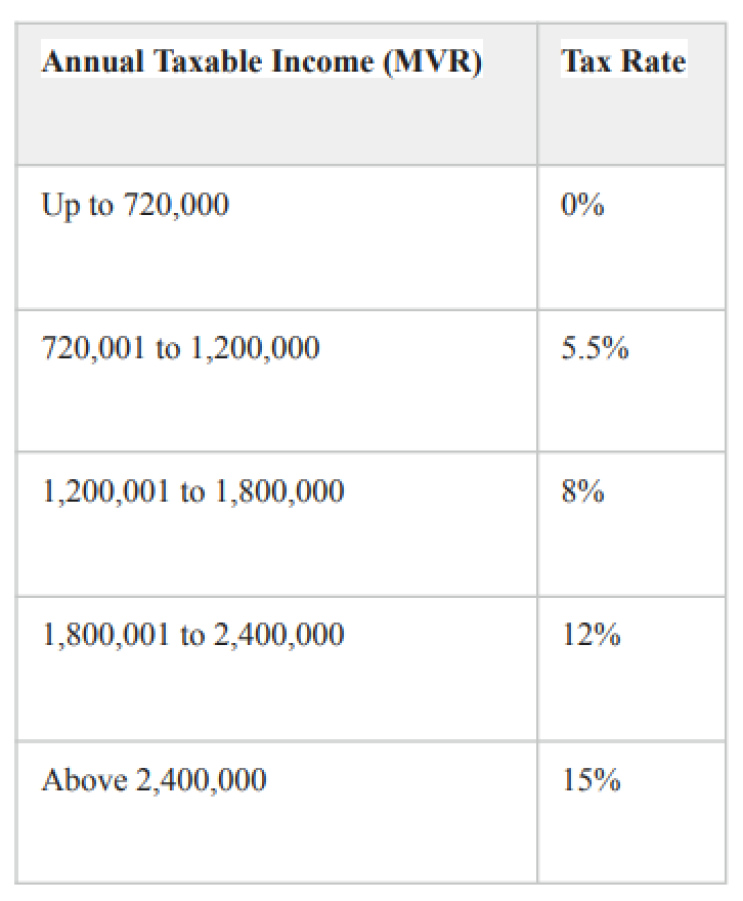
To protect low-to-middle-income earners, individual income tax features a progressive bracket structure:
For corporate entities and partnerships, a standard flat rate of 15 percent is levied on taxable business profits exceeding MVR 500,000. Commercial banking institutions, however, are carved out into a distinct tier, facing a corporate tax rate of 25 percent on their net taxable income.
Compliance and Administration
MIRA strictly regulates when and how to pay taxes to ensure consistent government cash flow. For regular employees, income tax is managed through a "Pay As You Earn" system. In this system, employers deduct the required tax from monthly salaries and must send it to MIRA by the 15th of the following month.
Conversely, corporations, partnerships, and individuals earning non-employment income operate on a staggered interim payment system. Rather than settling liabilities once a year, these taxpayers must submit three distinct payments over a continuous cycle:
- First Interim Payment: Due by July 31 of the ongoing tax year.
- Second Interim Payment: Due by January 31 of the following tax year.
- Final Payment & Return: Due by June 30 of the following tax year, settling any remaining balance.
Taxpayers with an annual income of MVR 20 million or more must submit their returns and pay their taxes electronically via the MIRAconnect portal.
Those below this threshold can file online or submit their documents and payments in person at MIRA collection centers.
National Fiscal Impact
Since its introduction, income tax revenue has become a key part of the Maldivian national budget, consistently ranking second to GST as a major source of domestic revenue. Income tax collections are categorized into Corporate Income Tax, Individual Income Tax, Withholding Taxes (for both residents and non-residents), and Bank Income Tax. Financial information from MIRA’s revenue reports shows that Corporate Income Tax and Bank Income Tax contribute the most to total collections.
For instance, during busy collection months like June, income tax receipts typically make up about 24 percent of total state revenue collected by MIRA, amounting to hundreds of millions of Maldivian Rufiyaa in that time.
The banking sector has shown significant growth; in 2024, Bank Income Tax revenue rose by 51.9 percent from the previous year, reaching MVR 1.4 billion due to growth in the financial sector GDP.
This growing pool of direct tax revenue decreases the state's vulnerability to external economic shocks and provides essential funds for developing public infrastructure, education, and healthcare systems across the atolls.


