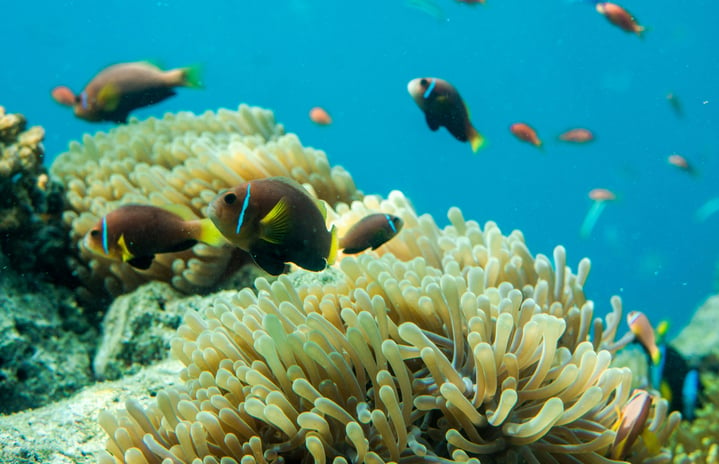
Maldives has always had a vast and unique but fragile ecosystem. Protecting the environment in Maldives must be paramount due to the environment being a key factor for tourism and because it is vital to both the survival of the nation and its people.
There are two major environmental issues that are plaguing the Maldives at this point in time. One of them is the threat of coral bleaching, a phenomenon that now has a chance of occurring almost yearly in the Maldives, with the most recent great bleaching event occurring in 2023.
The other issue is the development project of three 17-storey buildings at the Funavaa area in K. Villingili (Villimale’) which will require cutting down Alexandrian Laurel (Funa) trees that have been growing for a century.
Corals and Dredging: Maldives Resilient Reefs’ Request to the Government, Tourism Operators and to the Public
The Maldives Resilient Reefs (MRR) is a local NGO that has taken on the task of protecting and sustainably managing the coral reefs and ocean resources in Maldives.
According to MRR, the National Oceanic and Atmospheric Administration (NOAA) Coral Reef Watch (CRW) put Maldives under a Coral Bleaching Alert Level: Watch classification on 11th April 2026, which indicates a low chance of potential bleaching. However, on 13th April 2026, the MRR said that forecasts are expecting conditions to reach Alert Level 1, marking a likely bleaching event within the next 1 to 12 weeks.
MRR said that elevated sea surface temperatures (SST) over several weeks can cause coral bleaching, with coral mortality being a very real threat. But, their deaths can be mitigated if temperatures go back to normal fast enough. Maldives has already fallen victim to the global bleaching events that occurred in 1998, 2016 and 2023.
They have called on the Maldivian government to temporarily halt all dredging and land reclamation activities for at least two weeks after conditions are deemed “Normal” and for activities to be halted to four weeks if there is reef stress. They are requesting these activities be stopped for the time being as it can increase sedimentation and turbidity, which contributes to thermal stress on corals.
MRR has also called on tourism operators to halt beach replenishment and sand pumping activities during the period of risk. They are requesting tourism operators, the government and relevant institutions to ensure the proper treatment of any and all sewage in order to prevent nutrient pollution, which can impact reef resilience. They have also urged the public to exercise further caution when making use of reef areas.
The Environmental Regulatory Authority: Their Insight and Steps Taken Towards the Threat of Coral Bleaching
Regarding the threat of coral bleaching, the Director of the Environment Research and Conservation Section of the Environmental Regulatory Authority (ERA) Yoosuf Rilwan stated that coral bleaching impacts fast-growing corals more compared to slow-growing corals. The impact of humans caused by large-scale dredging, overfishing and discharge of pollutants such as sewage creates phase shifts where a coral dominated reef changes to an algae dominated reef which inhibits coral growth, which is something that should be stopped or minimized.
He went on to say that a special task force exists, housed at the Maldives Marine Research Institute (MMRI) to address bleaching in the country, meant to offer guidance to the government on steps to be taken should there be a bleaching event.
Rilwan noted that the ERA has conducted baseline studies at three locations to monitor coral reef health, where temperature loggers have been installed and surveys have been conducted to establish a baseline should a bleaching event occur. They are closely monitoring the situation and should bleaching be confirmed, only then should dredging activities be temporarily ceased, which was something the ERA did back in 2023 as well.
SaveMaldives: Protectors of the Land and Sea
SaveMaldives is an environmental campaign led by citizens and individuals from various backgrounds who hold genuine concerns over the irreversible destruction of the environment in Maldives.
As a part of SaveMaldives, Humaida Abdul Ghafoor filed a constitutional case to the High Court of Maldives in order to nullify the Gulper Shark Fishery Plan and Regulation in December 2025. While they are fighting this case on the ocean front, they have also submitted a constitutional case to the Supreme Court in regards to the chopping down of Funa trees to build three 17-storey buildings in Villimale’s Funavaa area.
SaveMaldives publicized an open letter on their website on 1st April 2026 and details about the constitutional case submitted by Humaida Abdul Ghafoor and Ahmed Ikram to the Supreme Court on Miveshi.com.
Their open letter spoke about how Villimale’ is the only real island-like place left in the Greater Male’ Region, a place they say has 41 percent of the nation’s population concentrated into one spot, which has brought about various issues in Male’ such as congestion, loss of trees, respiratory diseases / issues, to name a few.
The letter emphasizes the protection of the Funa trees in Villimale’, with the Funavaa being the area that has the oldest trees on the island, with more than 100 trees and Funa trees that are quite old. However, the letter reads that the government has awarded Rasheed Carpentry and Construction, via the Bank of Maldives (BML), a project to construct three residential towers standing at 17-storeys in January 2026. Information they had sources states that the three towers, which will total 300 flats, will greatly affect the Funavaa area.
The letter goes on to read that the Funa trees at Villimale’, Block No. 30 are included in the registry of protected plants. They are trees which are protected under the Environmental Protection and Preservation Act. They call on the government, and both public and private entities in charge of decision making to change the location of the project to anywhere but Villimale’.
Their case to the Supreme Court outlines four key matters:
- To order the government and the Male’ City Council to not conduct any projects that may result in the damaging of the protected trees in the area as no Environmental Impact Assessment (EIA) has been done, even though it is required under the Environmental Protection and Preservation Act and the Regulation for Protection and Preservation of Island Vegetation and Flora in the Maldives.
- To order the Male’ City Council to take necessary legal steps in protecting said trees as per the Regulation for Protection and Preservation of Island Vegetation and Flora in the Maldives.
- To order the government to halt the project as it goes against the Constitution and regulations.
- Under Article 22 and Article 23 of the Constitution, to order the protection and preservation of the environment for future generations as it is a fundamental duty, and in ensuring these rights, to order the government to enact their responsibilities under Article 3(B) of the Regulation for Protection and Preservation of Island Vegetation and Flora in the Maldives. Additionally, to proceed with development projects that in no way will harm any plant-life, wildlife or the environment as a whole, under Article 22 of the Constitution and any supporting acts, and to protect trees for 50 years under Article 3 of the Regulation for Protection and Preservation of Island Vegetation and Flora in the Maldives.
The Felling of Trees in Funavaa: The ERA and Their Role in the Matter
The Director of the ERA Yoosuf Rilwan also gave a statement about the felling of trees in Funavaa, stating that the ERA has lost a major portion of their authority on such matters under the current Regulation for the Protection and Preservation of Island Vegetation and Flora (2022/R-92), and that now, some responsibilities lie with city and island councils, responsibilities such as tree protection and removal, particularly for cases involving fewer than 50 trees.
As per the regulation, councils are to conduct tree surveys and provide a list of trees that are to be protected to the ERA for it to be endorsed. Even though the regulation states the various categories of protected trees, which includes trees over 50 years of age, the formal process regarding the protection of trees is launched via the respective councils, and that places limitations on ERA’s attempts to directly intervene.
Despite these challenges, the ERA has been active in their pursuance of amending and strengthening the regulation, with them having proposed amendments to the Ministry of Climate Change, Environment and Energy for consideration. It is the ERA’s belief that there should be harmony between development and the environment. While this has been going on, the ERA is currently conducting surveys across the Greater Male’ Region to update the list of protected trees as part of their ongoing efforts to strengthen conservation measures.


