
On a ferry to Hulhumale’, somewhere between the churn of the sea and the quiet observation of strangers, Naza found a poem.
She does not remember the exact lines now- only the feeling. The way human behaviour unfolds when people think no one is watching. The way a moment, ordinary and fleeting, can settle into the mind and demand to be written. That has always been her method: to witness, to feel, and then, when the world quiets down, to translate it into words.
It is perhaps fitting that her first book “Poet from the Isles”, is less a book of poems and more a map of inner landscapes; grief, solitude, love, courage. Charted through lived experience rather than literary pretense.
A childhood steeped in stories
Long before she wrote her first poem, Naza was already living inside language.
Her father was what she described, with quiet pride, as a “Dhivehi lhenveriya”- a Maldivian poet. He wrote verses for songs, stories for magazines like Aafathis, and carried with him the rhythms of a literary world that, in hindsight, shaped her more deeply than she realised at the time.
“I grew up seeing my dad write a lot,” she said. “Poems, stories… I witnessed that world.”
It was not a formal apprenticeship, nor a deliberate passing of the torch. If anything, Naza resisted the idea that writing was something innate. She considered herself “a good writer”, but nothing more. Poetry, in particular, seemed distant, something her father did, not her.
And yet, the seeds were there. The quiet observation. The attention to emotional detail. The understanding that words could carry weight beyond their surface.
What she lacked, at that stage, was a reason to write.
The poem that began with loss
That reason arrived in 2015, in the form of grief.
The first poem Naza ever wrote was about death. Specifically, the death of a close family member. She had attended the funeral, moving through the rituals and condolences, but inside she was struggling with something more private; the inability to express what she felt.
“I’m not somebody who knew how to express emotions too much, especially through talking back then,” she said.
So she wrote.
The poem, titled “Death” and now included in her book, was less an artistic exercise than an emotional release. It was a place to pour the “bottled up things” in her head, to make sense of something that refused to be spoken aloud.
When she finished, something shifted.
“I realised.. yeah, I can actually write poems.”
That moment of recognition did not arrive with fanfare. There was no declaration of becoming a poet. But there was a quiet understanding. That writing could hold what speech could not.
She has been writing ever since.
Over the next decade, Naza would go on to write more than a hundred poems. Yet her approach to poetry remains strikingly unadorned.
There is no obsession with elaborate metaphors or dense symbolism. No performative complexity designed to impress. Instead, her work leans towards clarity. Towards what she describes as “real life relatable” writing.
“The book is introspective,” she said. “It’s very good for self-reflection.”
The themes she explores are universal but deeply personal; solitude, grief, love, courage, and the unexpected detours that shape a life. These are not abstract ideas in her work; they are lived experiences, filtered through observation and reflection.

Take solitude, for instance. Often framed as something negative, even isolating, Naza approaches it differently.
“Some people may view solitude as something very negative,” she said. “But when you look at the other side, solitude is actually very beautiful.”
It is in solitude, she suggests, that one learns the most about oneself, that growth is not merely about moving forward, but about pausing long enough to understand where you are.
This emphasis on reflection sits at the heart of Poet from the Isles. The poems are not instructions or answers. They are invitations to feel, to process, to reconsider.
“If you don’t reflect, you won’t grow,” she added.
The discipline of noticing
If there is a single thread running through Naza’s work, it is attention.
Inspiration, for her, is not something that arrives on command. It cannot be summoned by sitting down and deciding to write. Instead, it emerges from experience, from moments lived, witnessed, or quietly absorbed.
“You have to experience a certain situation,” she explained. “Or witness a friend experience something. Then you sit and reflect on it.”
Travel, too, plays a role in this process. Not in the grand, escapist sense often associated with it, but as a way of observing human behaviour in unfamiliar contexts.
“When I travel to different places, I observe human behaviour and then reflect on that for my writing,” she said.
The poem she came up with on the ferry is one such example, a fragment of everyday life transformed into something more enduring. It is a reminder that poetry does not require extraordinary events. It requires only the willingness to notice.
Despite the emotional depth of her work, Naza’s writing process is surprisingly swift.
“Usually it takes me five to fifteen minutes to write a poem,” she said.
The speed, however, is not a reflection of haste, but of instinct. By the time she begins writing, the thoughts have already taken shape in her mind. The act itself is less about creation and more about transcription, about capturing something before it fades.
Refinement comes later, though even that is minimal.
“I like writing raw material,” she said. “When I write at the time, the rawness is there. It feels more alive.”
This preference gives her work a certain honesty. The poems do not feel overworked or overly polished. They retain the texture of the moment in which they were written. The urgency, the vulnerability, the clarity.
In an era where perfection is often prized over authenticity, this approach feels almost radical.
From private pages to public platforms
For years, Naza’s poems existed only in notebooks and phone notes, private reflections with no intended audience.
That changed in 2021.
By then, she had already written over a hundred poems. The question was no longer whether she could write, but whether she should share.
“I thought that I might get the poems to more readers if I made an Instagram account,” she said.
What followed was her entry into the digital poetry world. She created an account, after which she named her book :Poet from the Isles, and began posting selected poems, and tagged international poetry platforms to increase visibility.
The response was immediate.
By participating in small digital events and engaging with online communities, Naza’s work began to circulate beyond Maldives. Poetry networks featured her pieces. Readers from different parts of the world discovered her writing.
“My target was never to focus solely on Maldives,” she said. “I wanted to increase my poetry across different networks.”
And yet, the local response was equally strong. Readers in Maldives, particularly younger generations, found themselves reflected in her work.
“They said it is easy to read,” she recalled.. “Not so metaphorical that it loses its meaning. It is relatable.”
That relatability became her defining strength. In making her poems accessible, she made them personal, not just to herself, but to anyone willing to read.
She initially kept her identity separate from the account. There were no photos, no personal branding, just words and artwork. It was only after an interview with an international blogger in 2022 that the connection became public.
By then, it hardly mattered. The work had already found its audience.
Building a book from the ground up
If sharing her poetry online was a leap, publishing a book was a long held dream.
“For a decade, my dream was to publish the book,” she said.
But unlike many first-time authors, Naza did not rely on traditional publishing routes. Instead, she chose to do everything herself.
The process began, as many do, with research. She had no prior knowledge of publishing, no roadmap to follow. So she learned piece by piece how to turn a collection of poems into a manuscript.
She compiled her work into a single document, edited it, and shaped it into a cohesive collection. Then came the design.
“I wanted everything to be done on my own,” she said.
The cover art? Drawn by her.
The manuscript? Compiled and edited by her.
The final product? A reflection not just of her writing, but of her vision.
Printing, eventually, was arranged through a supplier in Sri Lanka. Distribution began modestly, through a website and her Instagram. But the reach has been steadily expanding.
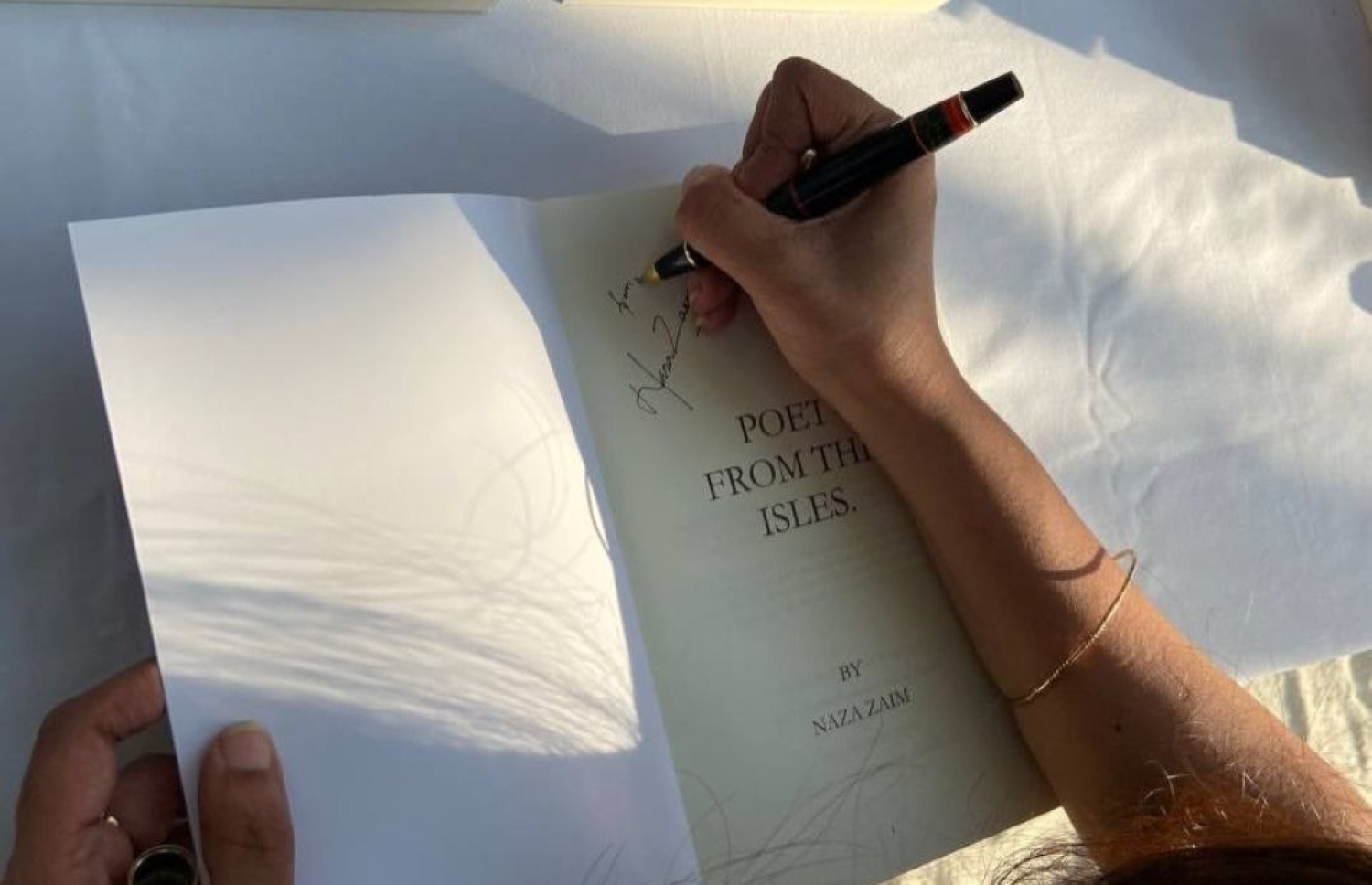
There are plans to take it further, to Amazon, to international readers, to resorts beyond the Maldives, Naza said.
But at its core, the book remains what it has always been: a deeply personal project, built from the ground up.
The weight of a single poem
Among the many poems in the collection, one stands apart.
“Voice of a Woman.”
It is, she said, the most personal piece in the book and perhaps the most universal.
The poem addresses experiences that are at once specific and shared; harassment, cyberbullying, abuse in its many forms. It does not narrate a single story, but rather captures a collective reality.
“It would not define a specific situation,” she explained. “But it is universally felt by every woman.”
In this sense, the poem becomes more than an expression. It becomes recognition, a way of saying, you are not alone in this.
That balance between the personal and the universal is what gives Naza’s work its resonance. She writes from her own experiences, but leaves enough space for others to find themselves within them.
The quiet challenges of being a poet
For all its emotional richness, poetry remains a difficult path, particularly in places where artistic careers are not always prioritised.
“In Maldives, there is not much recognition for artistic skillsets like writing,” Naza said.
This is not to say that there is no appreciation. There are readers, communities, even associations dedicated to poetry. But courses, the formal avenues for development, are still limited.
“It is a very literature-based skill,” she noted. “I would love to see short courses available here.”
Such opportunities, she believes, would allow emerging writers to refine their craft and take their work further. It is not just about individual growth, but about building a literary culture, one that can sustain and nurture new voices.
A future still being written
Naza is not done.
If anything, Poet from the Isles feels like a beginning, a first step in what she hopes will be a longer journey.
Readers have encouraged her to continue. Messages, reviews, quiet acknowledgements of how the book has resonated, all of it has reinforced what she perhaps already knew: that her work matters.
“I’m thinking about continuing to write,” she said. “And one day again I’m going to publish a second book.”
Beyond writing, her immediate focus is on expanding the reach of her current one, placing it in more resorts, connecting with international audiences, building on the visibility she has already achieved.
It is a pragmatic approach, grounded in both ambition and patience.
Her advice to young poets is simple, but pointed.
“Try to express,” she said. “Even if you’re not that good yet.”
The emphasis is not on perfection, or even on poetry specifically. It is in the act of expression itself, through writing, drawing, or any form of art that allows something inherent to take shape externally.
Because, as she learned a decade ago, expression is not just about communication. It is about understanding.
“The more you express,” she said, “you will find more meaning and impact in life.”
It is a sentiment that echoes through her work. Not as a grand declaration, but as a quiet truth.
The Poet from the Isles
There is something fitting about the title she chose.
Poet from the Isles is both specific and expansive. It roots her in place, in Maldives, in the rhythms of island life, but also suggests a voice that travels beyond it.
Through life’s journey, through solitude and shared experience, Naza has built a body of work that is at once intimate and accessible. In a world that often rewards noise, her poetry offers something quieter. Something slower. Something that asks not for attention, but for reflection.
And perhaps that is its greatest strength.
Because sometimes, all it takes is a moment, on a ferry, in a memory, in the space between thoughts, to realise that there is something inside you worth writing down.


