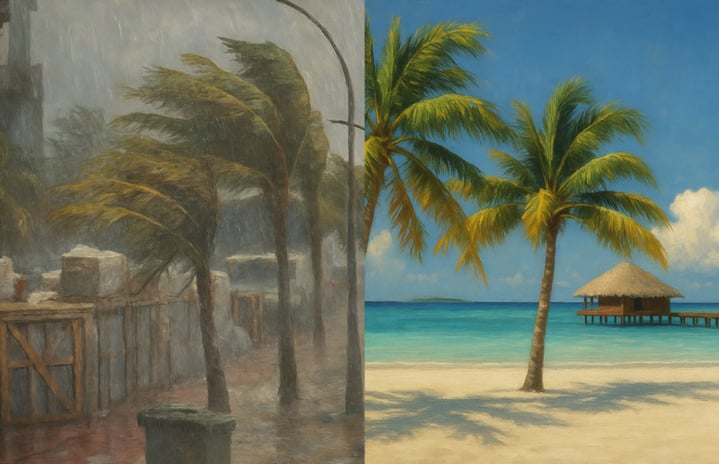
In Maldives where land is scarce, horizons are wide, and the ocean shapes both livelihood and identity, time has never been something measured only by clocks or calendars.
Long before digital weather maps and monsoon forecasts, Maldivians learned to sense the turning of the year in subtle ways; in the cooling of the wind at dawn, in the color of the evening sky, in the patterns of the waves rolling across the reef.
This innate understanding of the environment evolved into what locals call the “Nakaiy,” an indigenous Maldivian calendar system. The Nakaiy system predicts weather patterns, wind directions, tides, and conditions for activities such as fishing, agriculture, and seafaring.
More than a seasonal chart, Nakaiy is a navigational guide passed down through countless generations of fishermen and farmers acting as a reminder that survival often depends on the ability to listen to the world around us.
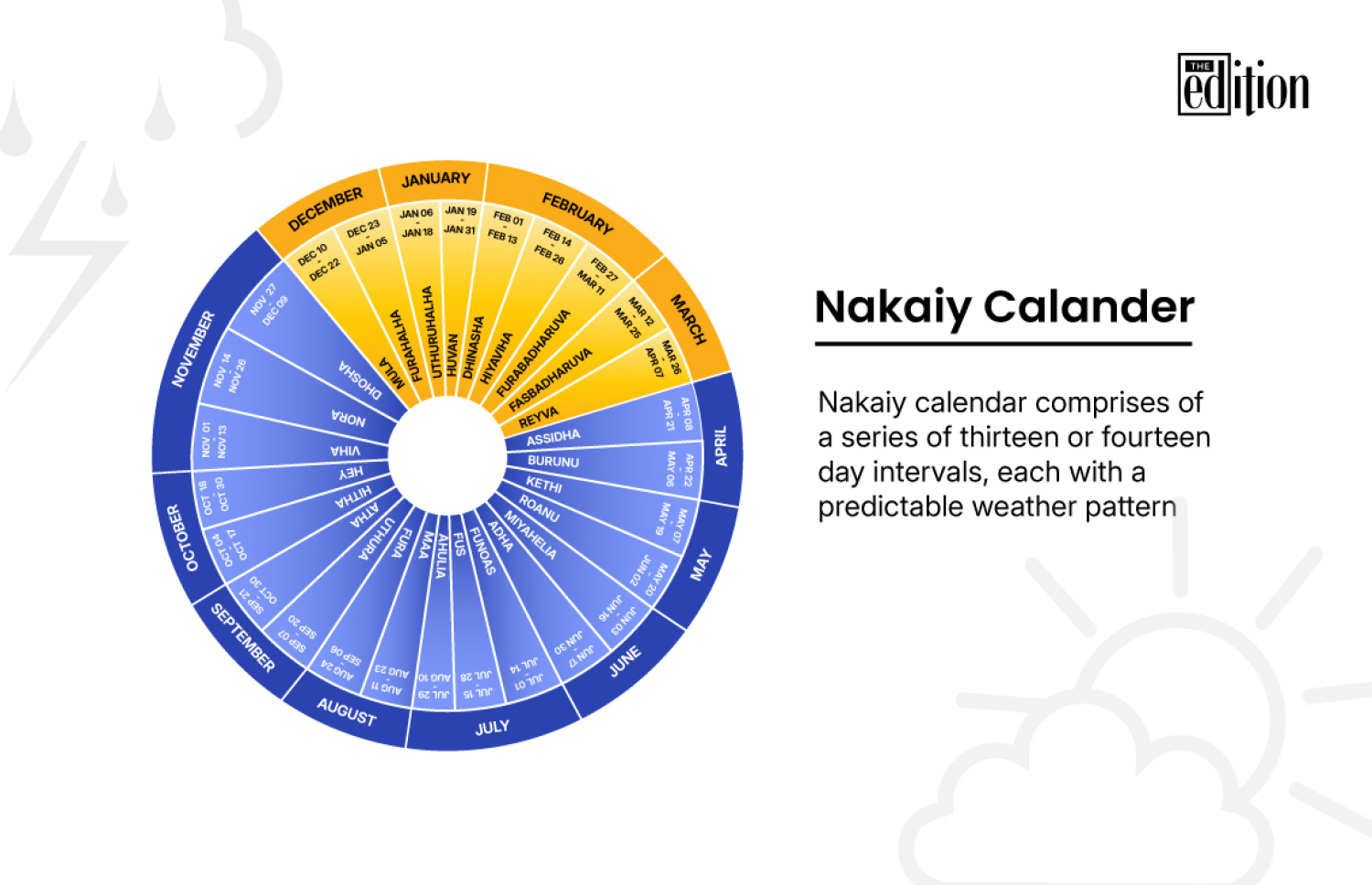
The Nakaiy divides the year into 27 distinct periods, each lasting 13 or 14 days and named after a star or constellation that rises at dusk during that interval.
Each period carries its own characteristic weather pattern, turning the night sky into a seasonal map. For seafarers navigating without compasses or charts, these markers in the sky served as both guide and guardian. Rooted in centuries of observation, this cultural inheritance has been passed down orally and through lived practice.
Each Nakaiy carries a detailed set of expectations:
- Weather predictions: whether to expect rain, thunder, shifting winds, or stretches of calm.
- Fishing: which waters are likely to see tuna migrating, and which seas may become dangerous.
- Agricultural pattern: when to plant, prune, or harvest.
This alignment of sky and sea offered a practical answer to an islander’s most important questions; When should we go out to fish? When should we plant our crops? When should we prepare for storms?
Monsoons Through the Lens of Nakaiy
The Maldives experiences two dominant monsoons:
- Hulhangu: the southwest monsoon, marked by heavy rains, strong winds, and rough seas
- Iruvai: the northeast monsoon, bringing dry, clear skies and calmer waters
The Nakaiy system breaks these broad monsoons into smaller, more nuanced phases, each holding its own set of warnings, expectations, and opportunities. To the untrained eye, the transition between these phases may seem subtle, but to those who have lived their lives by the sea, each Nakaiy is a distinct shift in the language of nature.
During Hulhangu, Nakaiy periods such as Roanu, Miyahelia, and Adha mark the arrival of intense weather with dense clouds, choppy seas, and unpredictable currents. The winds grow restless, the swells deepen, and the ocean takes on a darker, more brooding tone.
Seasoned fishermen, fully aware of the risks, often stay closer to the island or use this time to repair their boats, mend fishing lines, and prepare their gear for calmer days ahead. Even today, many rely on these Nakaiy cues to decide whether a journey is worth the gamble.
In contrast, Iruvai Nakaiy periods like Huvan, Dhinasha, and Fusbadhuruva announce a gentler rhythm. The seas settle into a glassy stillness, the winds soften, and the water clears to reveal brilliant reefs below. These are days made for travel, deep-sea voyages and reef fishing. The ocean becomes a vast, shimmering mirror, and long journeys across the atoll or to distant fishing grounds become easier and far safer.
When someone mentions a nakaiy, they are not merely noting a date. They are invoking an entire constellation of knowledge; the angle of the breeze, the likelihood of sudden afternoon squalls, the strength of the currents, and whether fish will stay deep or scatter along the atoll edge. For those who understand it, the Nakaiy transforms the year into a living map. One that speaks through wind, tide, and sky.
Modern meteorology uses satellites, Doppler radars, and predictive models, yet it is surprising how often Nakaiy forecasts align with scientific data. The accuracy comes from centuries of careful observation. People watched how rain behaved when a particular star rose, how the swell changed when seasonal winds shifted, and how fish migrated during specific currents.
For example; Fishing is excellent during Hey Nakaiy which falls between October 18-30 and there is an abundance of large tuna.
This system was the Maldives’ early form of climate science, refined over hundreds of years of trial, error, and careful attention.
Nakaiy in the Modern World
Today, smartphones offer hour-by-hour forecasts, and fishermen rely on GPS rather than stars. Yet the Nakaiy persists.
You still hear it in the quiet confidence of elders who anticipate a sudden turn in the wind long before an app issues an alert; in farmers who continue to time their garden beds around ancestral rhythms; and in seasoned seafarers who instinctively adjust their routes using knowledge honed over generations.
Even marine researchers and environmental scientists are revisiting Nakaiy to make sense of modern challenges like climate change. Many argue that traditional ecological knowledge fills the gaps that satellite data alone cannot.
By comparing today’s shifting weather patterns, unpredictable monsoons, and recurring coral bleaching events with historical Nakaiy records, scientists gain valuable context about long-term environmental changes shaping Maldivian ecosystems.
In this way, the Nakaiy is no outdated relic. It is a living archive; one that bridges ancestral wisdom and contemporary science, guiding communities through a rapidly changing world, reminding us how to live in harmony with a fragile environment.
A Legacy to Carry Forward
As the Maldives modernizes, the danger is not that the Nakaiy will disappear, but that we may forget how to read the world the way our ancestors once did. The system is a testament to Maldivian ingenuity- an intricate harmony of astronomy, observation, and intuition that allowed a small island nation to flourish in one of the planet’s most ocean-dominated landscapes.
Preserving it requires more than simply recording the names of the 27 periods. It means safeguarding a worldview in which the sea is a teacher, the sky a storyteller, and nature itself a trusted companion rather than an obstacle to overcome.
Whether you are a fisherman steering by the stars or a city-dweller refreshing a weather app, the Nakaiy invites you to pause, look up, and listen to what the world is already trying to say.


