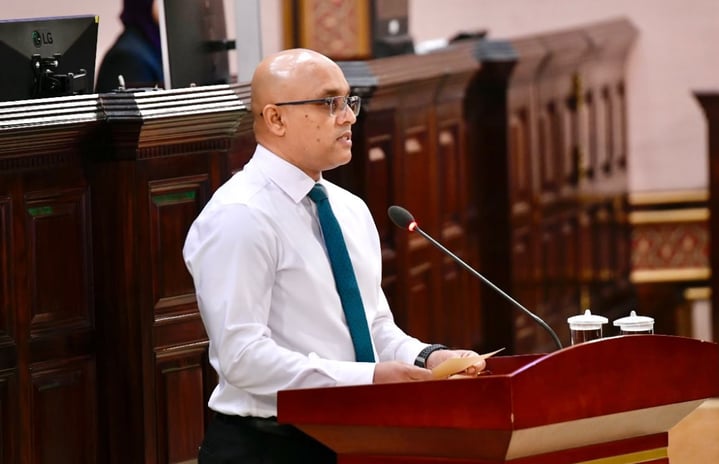
Finance Minister Hassan Zareer said the Maldives had spent this year repaying substantial debts and protecting the public from financial and economic shocks caused by the ongoing conflict in the Middle East.
Presenting next year’s state budget, Minister Zareer said the country faced its highest debt burden in history, with MVR 11.7 billion expected to be spent on debt repayments by the end of this year. The amount is expected to fall significantly next year, when the government will need to repay MVR 4.5 billion, he said.
Minister Zareer said the government’s debt repayment measures had strengthened confidence among international financial institutions and contributed to an improvement in the Maldives’ credit rating, describing the repayments as a major financial achievement.
He identified the impact of the Middle East conflict on tourism as another major challenge this year. Tourist arrivals fell by 23 percent in March and April amid the conflict, while arrivals so far this year are 3.6 percent lower than during the same period last year.
“Although the number of tourists arriving in Maldives is not expected to reach the level forecast for 2026, it is expected that the total number of tourists arriving in Maldives by the end of this year will be close to the total number of tourists arrived in 2025,” he said.
Minister Zareer said the conflict was the third major shock to the Maldivian economy in the past decade, but the country had continued to make progress despite the challenges.
Government revenue is also expected to exceed initial projections. Revenue was budgeted at MVR 40.3 billion for this year but is now forecast to reach MVR 41.7 billion, he said.
Minister Zareer said rising global oil prices and increased government expenditure had posed significant challenges to the economy. Higher fuel prices had increased electricity generation costs, the price of goods and the overall cost of living.
However, he said government measures to control fuel prices had allowed businesses to continue operating without disruption to the public.
“The cost of fuel subsidies aimed at providing cheap electricity to the people has increased significantly this year due to higher world oil prices. Thus, fuel subsidies are expected to cost MVR 3.8 billion by the end of this year. However, looking at the oil forecasts of financial institutions, they expect oil prices to fall next year,” he said.
Total spending on subsidies is expected to reach MVR 14.5 billion this year, compared with the MVR 10.5 billion allocated in the budget.
The government has projected MVR 3.2 billion in oil subsidy expenditure for next year.


