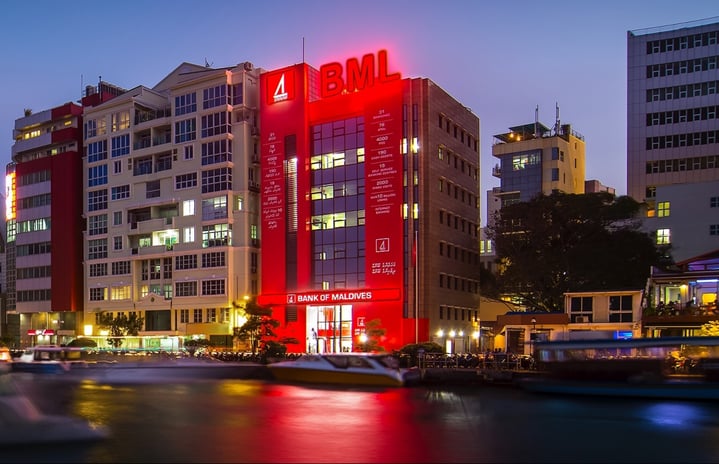
Bank of Maldives (BML) has been assigned a Long-Term Issuer Default Rating (IDR) of 'CCC-' with a Stable Outlook by Fitch Ratings. The agency also assigned the bank a Local Currency Long-Term IDR of 'CCC+', two scores above the sovereign rating, citing BML's strong standalone financial profile and resilience relative to the state.
The ratings follow Fitch's upgrade of the Maldives' Sovereign Long-Term Foreign Currency Issuer Default Rating to 'CCC-' on 3 June 2026. The upgrade came after the successful repayment of the government's USD 500 million sukuk in April and the implementation of revenue-side reforms, including the Foreign Currency Act.
As sovereign ratings act as a ceiling for domestic financial institutions, BML's ratings remain constrained by the country's sovereign rating despite the bank's underlying financial strength.
In its assessment, Fitch highlighted BML's dominant position within the Maldivian banking sector, pointing to its extensive nationwide network, digital banking capabilities and broad customer base spanning individuals, businesses and large corporates.
The agency said the bank's scale and market leadership provide a significant competitive advantage over local peers and support its ability to generate stable earnings.
Fitch also identified BML's strong capital position as a key rating strength. According to the agency, the bank's robust capital buffers are supported by internal capital generation, prudent risk management and a measured dividend policy, allowing it to support lending and economic activity while maintaining financial resilience.
The rating agency noted that Maldivian banks continue to operate in a challenging environment marked by persistent foreign currency shortages, which place pressure on sector-wide funding and liquidity. These constraints, Fitch said, reflect broader external imbalances within the economy.
Despite these challenges, Fitch said BML's strong franchise, stable deposit base and prudent liquidity management have enabled it to remain resilient through varying economic conditions. As the country's largest financial institution, the bank plays a key role in facilitating foreign currency flows, supporting economic activity and maintaining confidence in the financial system.
Fitch further noted that BML's lending portfolio reflects the structure of the Maldivian economy, with significant exposure to tourism and other major domestic sectors. While such concentration is typical of a small and relatively undiversified island economy, the agency said the bank's sector expertise, long-standing customer relationships and risk management practices support its ability to manage these exposures effectively.
Commenting on the rating, BML CEO and Managing Director, Mohamed Shareef, said the assessment recognised the bank's market leadership, strong capitalisation and resilient financial performance.
"We are pleased to publish our rating from Fitch Ratings, which recognises the fundamental strength of Bank of Maldives, our market leadership, strong capitalization and resilient financial performance," he said.
"The assessment underscores the strength of our bank and our ability to generate capital organically while maintaining prudent growth. Importantly, it also reflects our resilience in navigating the structural challenges inherent in a small island economy."
Shareef said the bank remained committed to supporting customers, contributing to national economic development and maintaining high standards of financial strength and governance.
The ratings reflect BML's strong standalone financial profile, market-leading position and robust capital base, while highlighting the resilience of its business model despite operating in a challenging macroeconomic environment.
While the Maldives is undertaking economic reforms, BML's rating reflects the importance of a national bank's role in maintaining financial stability and long-term economic growth.


